Tourism & Hospitality
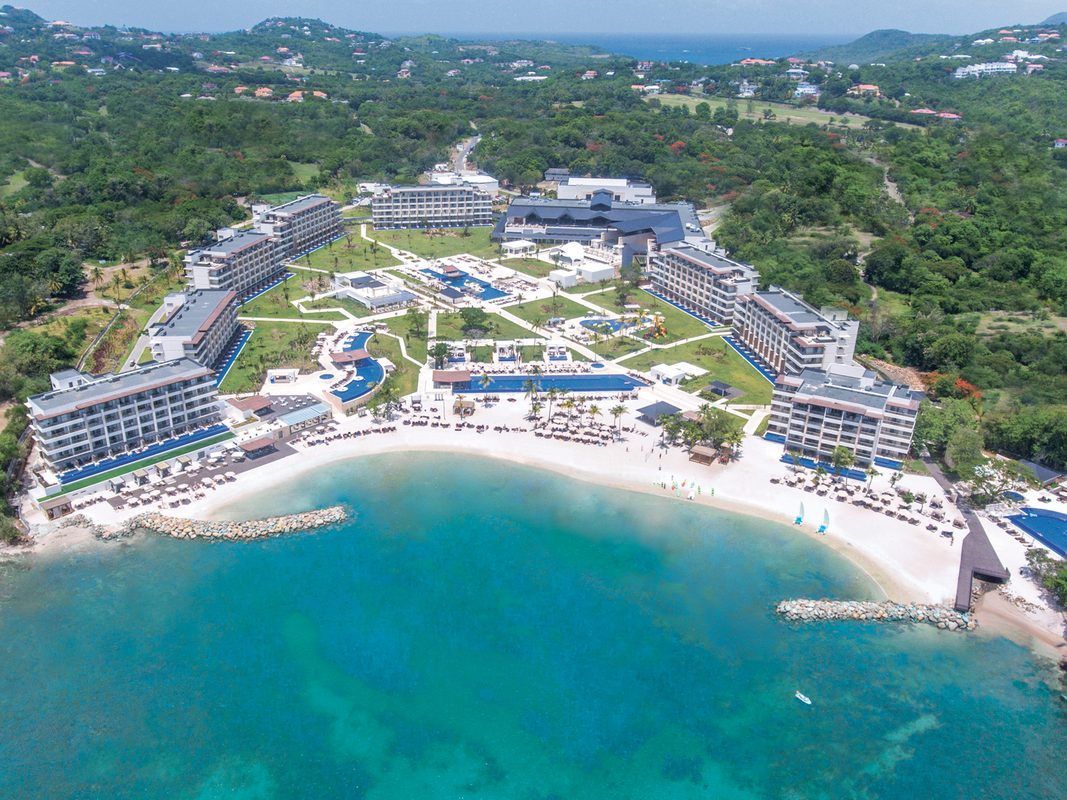
Stayover Arrivals Trend
| Year | Stayover | Cruise | Total Visitors | Tourism Revenue |
|---|---|---|---|---|
| 2019 (record) | 423,736 | 798,176 | 1,288,111 | EC$2,604M (~US$964M) |
| 2020 (COVID) | 130,695 | 297,885 | 458,943 | — |
| 2021 | 199,347 | 93,610 | 301,675 | EC$1,524M (~US$564M) |
| 2022 | 356,237 | 349,922 | 729,063 | EC$2,841M (~US$1,052M) |
| 2023 | 380,791 | 614,980 | 1,036,066 | EC$3,068M (~US$1,136M) |
| 2024 (new record) | 435,659 | 823,132 (459 calls) | ~1,259,000+ | — |
| 2025 (Jan–Nov) | ~385,160 (~4% YoY decline) | Target: 750,000 (2025–26 season) | — | — |
| Nov 2025 | +7% YoY (record November) | — | — | Best-performing month of 2025; late-year recovery |
| Metric | Value | Notes |
|---|---|---|
| Top Market – USA | ~65% of stayovers (2025) | Up from 57% in 2024, 45% in 2019; growing dominance driven by expanded US airlift |
| UK | ~12-15% (declining) | +4% in 2024, but down 15–23% in 2025; Virgin Atlantic & TUI withdrew direct London services; only BA remains |
| Caribbean | ~17% surge (2024) | Boosted by Carnival, Jazz Festival, cricket |
| Canada | Declining | Warning: down 16–22% in 2025 (IMF/SLTA) |
| Avg. Length of Stay | 7.9–8.7 nights | UK visitors longest at ~10 nights |
| Direct Employment | ~16,500 jobs (21.5%) | Highest job quality in Caribbean tourism (WTTC) |
| Total Employment | ~36,000 jobs (46.3%) | Direct + indirect + induced |
| Hotel Room Stock | ~5,500-6,500 rooms | ~2,000 new rooms in pipeline (+20% capacity). Secrets (355 rooms) opened Jun 2025. Cas en Bas (90 suites), Courtyard Marriott (140), Sapphire Sands (9 villas) opening 2026. |
| Caribbean Occupancy (2024) | 70.8% | ADR US$374; RevPAR US$265 |
Airline Connectivity (Hewanorra — UVF)
| Market | Airlines | Key Routes |
|---|---|---|
| USA | American, JetBlue, Delta, United | Miami (daily + 2nd daily Oct–Jan), Charlotte, JFK (8 flights/week total: AA resumed Dec 20, 2025; JB daily + 2nd weekly Sat from Nov 22, 2025), Philadelphia, Boston (JB 2x/week), Atlanta (Delta daily + 2nd daily Dec 2025), Newark, Chicago ORD (United Sat from Nov 2025) |
| UK | British Airways ONLY | London Gatwick (sole UK nonstop since 2025). Virgin Atlantic withdrew after 21 years of London–St Lucia service. TUI halted Gatwick direct. Major connectivity loss for UK market. |
| Canada | Air Canada, WestJet | Toronto (2x weekly each) |
| Caribbean (via SLU) | InterCaribbean, Caribbean Airlines, LIAT 2020, Sunrise | Barbados, Dominica, St. Vincent, Port of Spain |
American Airlines expanded Charlotte and Miami capacity by 53% in 2024, driving US arrival growth. For winter 2025–26, American resumed JFK–UVF (Sat from Dec 20, 2025) and added a 2nd daily Miami flight (Oct–Jan); JetBlue added a 2nd weekly JFK service (Sat from Nov 22, 2025), bringing JFK–UVF to 8 flights/week total; Delta added a 2nd daily Atlanta flight (Dec 2025–summer 2026); JetBlue added a 2nd Boston flight; United resumed Chicago ORD Sat (Nov 2025–summer 2026). Total US airlift: +12,000 additional seats, ~4% capacity growth for winter 2025–26. JetBlue, American Airlines, and United are all maintaining or expanding Caribbean routes. ~49 flights/week to 9+ non-stop destinations from George F.L. Charles (SLU) for inter-island services.
UK Airlift Crisis (2025)
Virgin Atlantic withdrew its London–St Lucia route after 21 years of continuous service, a major blow to UK connectivity. TUI also halted its Gatwick direct service. British Airways is now the only remaining London nonstop to St Lucia. UK arrivals dropped 15–23% in 2025, and Canada declined 16–22%. The US market now accounts for approximately 65% of all stayovers, raising concerns about over-reliance on a single source market. The SLTA and Tourism Minister are actively seeking replacement UK carriers and exploring charter arrangements.
Cruise Industry
The 2024–25 cruise season set a new record: 823,132 passengers on 459 ship calls, up from 614,980 on 264 calls the prior season—a 17.6% YoY passenger increase. Total cruise tourism expenditure (2024): US$72.7 million (FCCA). Average spend: US$104.36 per shore visit. Peak month: December 2024 (135,000 passengers on 62 ships). 20+ cruise lines call at Saint Lucia, including Royal Caribbean, Carnival, Celebrity, MSC, and Disney. However, 2025 cruise arrivals declined 11% during the peak season.
Cruise Revenue Reality Check
Cruise passengers represent 50%+ of total visitor arrivals but contribute only 8–10% of tourism revenue. Stay-over tourists spend US$103–531/day compared to cruise passengers at ~US$104/visit. The head tax is $12.50/passenger total, restructured so the government retains only $2.50 ($10 goes to GPH under the 30-year port concession since May 2024). This revenue structure has drawn criticism given the scale of cruise operations.
Port Facilities & Expansion
| Pointe Seraphine | Larger/modern terminal, 25+ duty-free shops, new dolphin berth accommodating 2 Quantum-class ships simultaneously |
| La Place Carenage (QE II Wharf) | Downtown location, 6 berths, indoor mall shopping |
| Max Capacity | 5 ships simultaneously on peak days |
| Port Operator | Global Ports Holding (GPH) — 30-year concession (since May 2024) |
GPH Port Expansion (completion target Oct 2026): Berth expansion for Icon/Oasis-class mega-ships (6,500+ passengers), new boardwalk to downtown Castries, new Vendors Arcade + Fishermen's Village at Banannes Bay, Soufriere waterfront revitalisation for tenders. Target: 1 million+ cruise passengers annually. Demolition and reconstruction underway since January 2025, with October 2026 completion target. The 2025–26 cruise season target is 750,000 passengers.
Shore Excursion Opportunities
Top shore excursions: Soufriere volcano/mud baths, Pigeon Island, catamaran cruises, ziplining, rainforest tours. Major operators: Cosol Tours, Spencer Ambrose Tours, Island Man Taxi. Private tour groups: ~US$45/person. Licensed tour operators can contract directly with cruise lines for passenger excursions.
Hotel Development Pipeline (2025–2027)
| Project | Rooms | Status |
|---|---|---|
| Secrets St. Lucia Resort & Spa (Hyatt Inclusive Collection) | 355 | Opened June 1, 2025, Choc Beach. All-inclusive, adults-only. Hyatt brand. |
| Cas en Bas Beach Resort (Destination by Hyatt) | 90 suites | Phase 1 sold out. Cap Estate. Julien Alfred (Olympic gold medalist) as brand ambassador. Opening 2026. |
| TheLifeCo Wellness (A'ila Phase 1) | 65 | Opened 2025 |
| Courtyard by Marriott, Pointe Seraphine | 140 | Under construction, opening 2026 |
| Sapphire Sands Villas (Bay Gardens) | 9 villas | Opening February 2026, Rodney Bay |
| A'ila Palm Family Hotel (Phase 2) | 153 | Under construction, 2026 |
| Grand Hyatt Saint Lucia, Choiseul | 345 | Pre-construction, 2026 (delayed) |
| A'ila Cove Adults-Only (Phase 3) | 320 | Planned, 2027 |
| Cabot Saint Lucia, Cap Estate | 320 homes + 40-suite hotel | Point Hardy Golf Club open. Horizon Villas (from $5.6M) + Fairway Residences ($3M–$5M) delivering 2025–26. Clubhouse 2026. |
| La Belle Hélène (Windjammer Landing) | 10 luxury villas | Announced 2025; near the Pitons. Windjammer undergoing US$40M renovation. |
Mega-Projects & Major Expansions
| Project | Scale | Status |
|---|---|---|
| Pearl of the Caribbean, Vieux Fort | US$2.6B master plan: luxury resort, marina, golf, commercial district, residential | 15-year phased development |
| A'ILA (full build-out) | 312 residential units, 90 luxury villas, 21 restaurants, $870M–$1.3B total | Phase 1 opened 2025; Phases 2–3 under construction / planned |
| Coconut Bay | US$80M expansion + US$24M renovation | Underway |
| Windjammer Landing | US$40M renovation + La Belle Hélène estate | Announced 2025 |
Tourism is the backbone of Saint Lucia's economy, generating the bulk of foreign exchange and employment. The island is consistently ranked among the top Caribbean destinations.
Sub-sectors
- Luxury Resorts & Hotels - High-end properties like Jade Mountain, Sugar Beach, Sandals. Strong demand for boutique hotels.
- Eco-Tourism & Adventure - Rainforest tours, volcanic attractions, diving, hiking, zip-lining. Growing segment.
- Cruise Tourism - Record 2024–25 season: 823,132 passengers on 459 calls. GPH US$135M port redevelopment underway (completion Oct 2026). Shore excursion opportunities.
- Wellness Tourism - Spa resorts, volcanic mud baths, thermal springs. Emerging high-value niche.
- Wedding & Romance Tourism - St. Lucia is a top destination wedding location globally.
- Cultural Tourism - Jazz festival, carnival, Creole heritage, food tourism.
- Yachting & Marina - Rodney Bay Marina (253 slips, max 285 ft), Marigot Bay (42 slips, max 280 ft). Charter license fees EC$200–EC$1,350. ARC Rally host since 1986 (~145 boats in 2025). Growing sailing/charter industry.
Top Attractions & Activity Pricing
| Attraction | Price (USD) | Notes |
|---|---|---|
| The Pitons (UNESCO) | $60-$200 | Gros Piton guided hike (2,530 ft) |
| Sulphur Springs (drive-in volcano) | $40-$80 | ~200,000 annual visitors; mud baths |
| Full-day catamaran to Soufriere | $100-$175 | Most popular tour; snorkeling, waterfalls |
| Scuba diving (2-tank) | $100-$160 | Anse Chastanet reef, Superman's Flight |
| Rainforest zipline | $80-$120 | Morne Coubaril Estate, Soufriere |
| Hotel Chocolat tree-to-bar tour | $125 | With lunch at Rabot Estate |
| Whale & dolphin watching | $55-$100 | Best: Dec-Apr |
Incentives
Tourism Incentives Act provides: tax holidays for approved hotel projects, duty-free import of building materials and equipment, training subsidies. Invest Saint Lucia facilitates approvals.
Opportunities
- Boutique hotel development (underserved mid-range segment)
- Eco-lodge and agro-tourism experiences
- Tour operator services and activity providers
- Restaurant and food/beverage concepts
- Technology solutions for tourism sector
Agriculture & Agri-Business
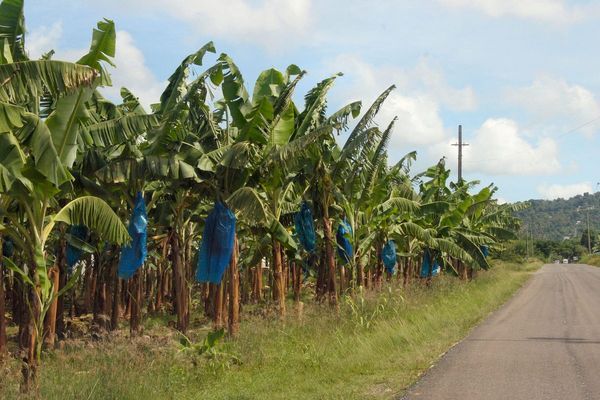
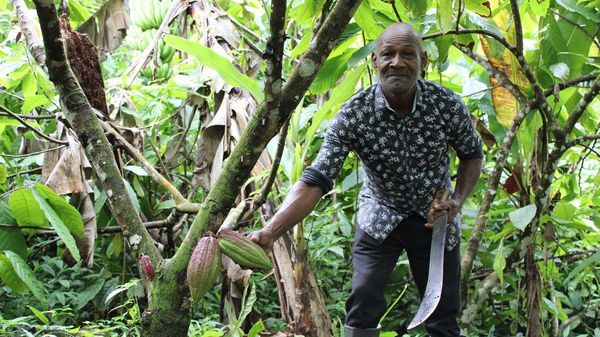
While declining from its historic dominance, agriculture remains a significant employer and a government priority for food security and export diversification. Most farms are less than 5 acres, and the sector is dominated by smallholder farmers. A new Census of Agriculture and Fisheries was conducted in 2024 (the first in 17 years), providing the first comprehensive data on the sector since 2007. The agriculture sector rebounded by 3.6% in 2024, aided by improved weather conditions.
Food Import Dependency — Critical Vulnerability
Saint Lucia's food import bill reached EC$1.5 billion (~US$556M) in 2023 (ECCB Food Import Bill Tracker), with an estimated 80–90% import dependency. Food imports represent 27.64% of all merchandise imports. Agriculture contributes less than 3% of GDP but provides 20% of jobs, with approximately 18% of land used for agriculture (most farms under 5 acres). The CARICOM "25 by 2025" target for reducing the regional food import bill has been extended to 2030. Food prices have risen steadily since 2020, with all import categories seeing 8–31% price increases.
Top import categories: Fats & oils (31.3%), dairy/eggs (17.9%), meat/seafood (16.5%), staples/cereals (15.4%), sugar/honey (15.2%), fruits/vegetables (10.7%). Primary source countries: USA, Trinidad & Tobago, UK, Jamaica, Barbados, France.
The government's Seven Crops Import Substitution Programme targets self-sufficiency in cabbage, tomato, lettuce, sweet pepper, watermelon, cantaloupe, and pineapple, with 100% self-sufficiency targeted for tomato, pineapple, sweet pepper, and watermelon. Saint Lucia is currently self-sufficient only in eggs.
Food Security Strategy (2025)
| Initiative | Details |
|---|---|
| National Food & Nutrition Security Task Force | Established to coordinate food security policy across government |
| 3-Year Strategic Plan | Comprehensive plan for boosting domestic food production |
| National Meat Processing Facility | Under design; aims to reduce frozen meat imports |
| Hydroponics Centre | SLU-Guyana collaboration — uses 95% less water than conventional farming |
| Aquaponics Training | 50 persons trained (2023, Taiwanese partnership) |
| Local Poultry Target | 35–40% of consumption (currently mostly imported) |
Food Processing & Retail Landscape
| Company / Chain | Details |
|---|---|
| Baron Foods Ltd (Vieux Fort) | 150+ products, FSSC 22000 certified, exports to 35+ countries (US/Canada/Europe/Caribbean) |
| Windward & Leeward Brewery | Piton Beer (Heineken subsidiary) — #1 export product (~$11.3M) |
| Viking Traders (est. 1979) | 100+ award-winning food products |
| Winfresh (govt-owned) | Pepper sauces, agricultural exports |
| Massy Stores | 13 locations (largest chain, acquired Super J IGA 2016) |
| Cost-U-Less | Warehouse-model supermarket |
| CFL / Glace / Shoprite | Additional supermarket chains serving the domestic market |
Grocery costs (2026): Local produce is very affordable (bananas EC$2.21/lb, eggs EC$11.32/dozen). Imported goods are 30–50% more expensive than North America. Monthly grocery budget: US$350–500 (single, budget) or US$900–1,250 (family of 4). Seven industrial estates with factory shells (370–2,970 m²) are available for food processing ventures.
Agricultural Production Overview
| Crop / Product | Acreage | Est. Annual Production | Primary Market | Trend |
|---|---|---|---|---|
| Bananas | ~14,826 acres | ~7,000–10,000 tonnes | Canada (new 2024), domestic | Declining (132K tonnes peak 1992; exports ~US$1.03M in 2023) |
| Coconuts | ~12,400 acres | ~3,500 tonnes | Domestic, regional export | Stable / revitalisation underway |
| Cocoa | ~1,700 acres | ~150–200 tonnes | Premium export (UK, EU) | Growing (agritourism-driven) |
| Dasheen (taro) | ~800 acres | ~1,200 tonnes | Domestic, diaspora (UK/Canada) | Stable |
| Yams | ~500 acres | ~800 tonnes | Domestic consumption | Stable (planting material shortages) |
| Sweet potato | ~400 acres | ~600 tonnes | Domestic consumption | Stable |
| Breadfruit | Mixed cultivation | ~500 tonnes | Domestic (staple food) | Stable |
| Mangoes | Mixed cultivation | Seasonal surplus | Domestic, some export | Stable (processing potential) |
| Vegetables (7 Crops) | ~1,500 acres | ~2,000 tonnes combined | Domestic (import substitution) | Growing (govt. priority) |
| Sea moss | Coastal aquaculture | ~200+ tonnes (dried) | USA, Canada, Caribbean export | Rapid growth |
| Honey | 190–280 hives | ~5–10 tonnes | Domestic, emerging export | Growing (IDB-funded cluster) |
| Coffee | ~50 acres (est.) | Small-scale | Domestic specialty market | Emerging (micro-producers) |
Most tropical fruits (passion fruit, guava, soursop, golden apple, papaya) are grown year-round in mixed cultivation for domestic consumption with limited processing. CARDI (Caribbean Agricultural Research & Development Institute) maintains a demonstration centre supporting root crop planting material multiplication for farmers.
Export Overview
Total exports: ~US$53.5M (2022). Saint Lucia runs a significant trade deficit (~US$465M), making export growth a national priority.
| Top Exports | Value | Destination |
|---|---|---|
| Piton Beer | ~$11.3M | OECS countries |
| Sea Moss | ~$5.6M (2024) | USA, Canada, Caribbean |
| Gravel & Crushed Stone | ~$5.7M | Regional |
| Paper Containers | ~$3.4M | Regional |
| Rum & Spirits | ~$2.8M | Worldwide |
| Bananas | ~$1.0M | Canada (new market 2024) |
Top export destinations: USA (~$9.2M), Guyana (~$8.7M), Trinidad & Tobago (~$7.6M), Barbados (~$4.7M). The “Taste of Saint Lucia” brand (launched 2018 by Export Saint Lucia) promotes premium local products internationally.
Banana Industry — Decline & Diversification
The banana industry was once the backbone of Saint Lucia's economy, generating up to 70% of export income and employing over 25% of the workforce at its peak. The decline is one of the most dramatic agricultural transformations in the Caribbean.
Banana Industry Timeline
| Year | Event | Production / Impact |
|---|---|---|
| 1953 | Geest Industries signs contract with Banana Growers' Associations | Industry formalised; preferential UK market access |
| 1960s–70s | Rapid expansion; bananas overtake sugar as primary export | 50,000–80,000 tonnes; 60–70% of export revenue |
| 1980s | Peak era; consistent exports above 100,000 tonnes annually | Up to 70% of export income; ~25,000 employed |
| 1992 | All-time production peak | 132,854 tonnes; US$71M revenue; ~10,000 farmers |
| 1993 | EU Single Market Banana Regime replaces Lomé Convention preferences | Limits preferential access for ACP bananas; beginning of decline |
| 1995–97 | WTO rules against EU banana preferences (Chiquita/US challenge) | Production drops 50% by 1997; farmers begin abandoning crop |
| 2005 | Continued decline; diversification programmes launched | ~30,000 tonnes; US$31M revenue; ~1,800 farmers |
| 2010 | Hurricane Tomas (Oct 2010) devastates farms island-wide | Significant crop losses; further farmer attrition |
| 2017 | WINFA (Windward Islands Farmers Association) consolidates Fairtrade efforts | Saint Lucia emerges as sole Windward Island Fairtrade banana exporter |
| 2022 | UK banana trade suspended | ~7,015 tonnes; ~500 farmers remain |
| 2024 | NFTO ships first bananas to Canada (new market) | Production exceeding demand early 2024; Tropical Storm Bret destroys 75% of crop |
Saint Lucia is now the only Windward Island still selling Fairtrade bananas. The NFTO (National Fair Trade Organisation) is farmer-owned and operated. The government provided over $400,000 in input subsidies through the NFTO. The Taiwan Technical Mission introduced drought-resistant and wind-resistant banana varieties (Tai-Chiao No. 2) to improve resilience.
Cocoa & Chocolate
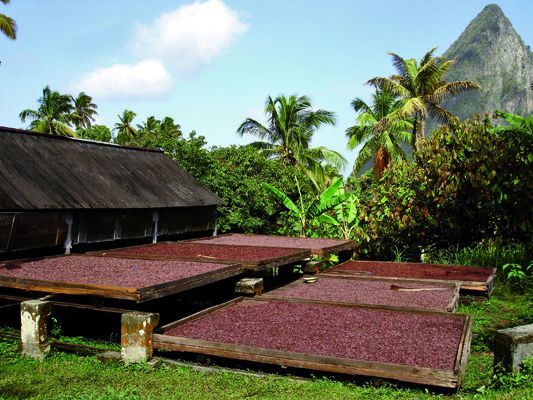
Premium Status
Saint Lucia is one of the top 9 exporters of 100% fine or flavourful cocoa and one of the top 23 producers of premium cocoa worldwide. Over 1,700 acres under cocoa. Criollo-rich Trinitario variety from volcanic soil at ~1,000 ft elevation. Harvest: Oct/Nov and Feb/Mar.
| Estate / Producer | Location | Products & Tourism Offering | Pricing (USD) |
|---|---|---|---|
| Hotel Chocolat / Rabot Estate | Soufriere | 140-acre estate (oldest working cacao farm). “Project Chocolat”: 25 eco-lodges, Tree to Bar tours, Cacao Bar, Ice Cream of the Gods. On-island chocolate factory under construction. | $125 (tour + lunch) |
| Cacoa Sainte Lucie | Canaries | Founded 2011 by pastry chef Maria Jackson. Micro-batch gourmet dark chocolate, truffle-making classes, farm excursions. | $40–$65 |
| Fond Doux Eco Resort | Soufriere | 135-acre working cocoa plantation with eco-resort. Full tree-to-bar guest experience, heritage cottage accommodation. | $30–$60 (tour); resort from $180/night |
| Morne Coubaril Estate | Soufriere | 400-acre 18th-century sugar/cocoa plantation. Historical adventure park, cocoa tours, zipline, horseback riding. | $11–$110 per activity |
| Emerald Estate | Soufriere | Organic cocoa farm with farm tours, chocolate tasting. Growing agritourism operation. | $25–$45 |
Saint Lucia celebrates Chocolate Heritage Month annually in August. The Saint Lucia Tourism Authority promotes the Cocoa Trail as a curated agritourism experience connecting multiple estates in the Soufriere district.
Coffee
Saint Lucia has a small but emerging specialty coffee sector. The volcanic soil and rainforest microclimates at 1,000–2,000 ft elevation provide ideal conditions for arabica cultivation. Key producers include:
- Le Verrier Farm (Soufriere) — 10-acre rainforest parcel at ~1,950 ft elevation; arabica production in fertile volcanic soil
- Noble Tree Coffee & Cocoa — Growers, processors, and roasters; handpicked coffee cherry; bean-to-cup model
Coffee production is currently small-scale and primarily serves the domestic specialty market. There is significant potential for expansion given suitable growing conditions and the premium positioning of “single-origin Caribbean coffee” in North American and European markets.
Root Crops, Vegetables & Fruits
Root crops are a dietary staple and cultural cornerstone. Dasheen (taro), yams, sweet potato, cassava, and tannia are grown primarily for domestic consumption, with some dasheen exported to the UK/Canadian diaspora markets.
| Category | Key Crops | Market | Notes |
|---|---|---|---|
| Root crops | Dasheen, yams, sweet potato, cassava, tannia | Domestic + diaspora export | Planting material shortages; CARDI multiplication plots |
| 7 Crops Programme | Cabbage, tomato, lettuce, sweet pepper, watermelon, cantaloupe, pineapple | Domestic (import substitution) | Govt. target: 100% self-sufficiency in 4 of 7 crops |
| Tropical fruits | Mango, passion fruit, guava, soursop, golden apple, papaya | Domestic, tourism | Year-round; high processing potential |
| Breadfruit | Breadfruit (artocarpus altilis) | Domestic staple | Cultural food; growing value-added processing interest |
| Plantains | Cooking plantain | Domestic | Often intercropped with bananas; Tropical Storm Bret losses |
| Coconuts | Coconut (12,400 acres) | Domestic + export (oil, water) | Revitalisation programme: virgin coconut oil, coconut water |
Livestock & Poultry
The livestock sector is small but strategically important for food security and import substitution of frozen meats.
| Sub-sector | Est. Production | Self-Sufficiency | Status |
|---|---|---|---|
| Poultry (broilers) | ~1,440–1,460 MT (2023–2028 proj.) | Partial (significant imports) | Largest livestock sub-sector |
| Eggs | Domestic supply | Self-sufficient | Only fully self-sufficient animal product |
| Pork | ~300–400 MT | Partial | Government increasing support |
| Cattle (beef & dairy) | Limited | Low | Efficient breeds introduced; dairy unit development |
| Sheep & goats | ~100–200 MT | Low | Government promoting to reduce frozen meat imports |
In 2024, the CERC-UBEC project imported 20 new resilient animal breeds from the USA (cattle, sheep, goats, pigs) selected for tropical acclimatisation. Government subsidies on animal feed and training programmes support smallholder livestock farmers.
Rum & Spirits
Saint Lucia Distillers (est. 1972, Roseau Valley) produces over 25 rums using 4 still types: 2 John Dore copper pot stills, 1 Vendome hybrid still (1,364L), and 1 Coffey column still (4,500 LPA/day). Named “Distillery of the Year” at the World Spirits Awards. CEO Margaret Monplaisir; Head Blender Deny Duplessis.
| Brand | Category | Notes |
|---|---|---|
| Chairman's Reserve | Premium | Blended since 1999. ~5 years aged. IWSC Gold Medal 2021. |
| Chairman's Reserve Forgotten Casks | Super Premium | Inspired by barrels surviving the 2007 arson fire. Extended aging. |
| Admiral Rodney | Super Premium | HMS Formidable, Princessa, Royal Oak expressions. Multiple international Golds. |
| 1931 | Super Premium | 6-11 year blend in bourbon/port casks. 46% ABV. 80th anniversary release. |
| Bounty Rum | Standard | The original branded rum (1972). 2-year double-distilled blend. |
Piton Beer (Windward & Leeward Brewing, Heineken subsidiary, first brewed 1992) is Saint Lucia's #1 export product (~$11.3M). 7 Monde Selection Awards. WLBL partnered with Antillia Brewing Company for pasteurised craft beers for export.
Food Processing & Manufacturing
| Company | Location | Key Products | Markets | Employees |
|---|---|---|---|---|
| Baron Foods Ltd (est. 1991) | Vieux Fort Industrial Estate | 165+ products: hot sauces, condiments, spices, dressings, banana ketchup, drink cocktails | 35+ countries (USA, Canada, Europe, China, Africa, Caribbean) | 200+ (3 plants: SLU, Grenada, T&T) |
| Saint Lucia Distillers (est. 1972) | Roseau Valley, Castries | 25+ rums (Chairman's Reserve, Admiral Rodney, 1931, Bounty), liqueurs | Worldwide (USA, UK, EU, Caribbean) | ~100+ |
| Windward & Leeward Brewery (est. 1975) | Vieux Fort | Piton Beer, Heineken, craft beers (Antillia partnership) | OECS regional (~$11.3M export) | ~150+ |
| Cacoa Sainte Lucie | Canaries | Micro-batch gourmet dark chocolate, truffles | Domestic, tourism, limited export | ~10–15 |
| Hotel Chocolat (Rabot) | Soufriere | Bean-to-bar chocolate, cocoa products. On-island factory planned | UK export, domestic tourism | ~50+ |
| Various sea moss processors | Vieux Fort, Praslin | Dried sea moss, sea moss gel, drinks | USA, Canada, Caribbean ($5.6M in 2024) | 100+ (farming + processing) |
Baron Foods is FSSC 22000 certified and FDA compliant, a model for Caribbean food export manufacturing. The company announced a multi-million dollar expansion at its Vieux Fort facility. Other processors include small-scale producers of coconut oil, honey, and tropical fruit preserves promoted under the “Taste of Saint Lucia” brand.
Sea Moss Industry
Sea Moss — Saint Lucia's Fastest-Growing Agricultural Export
Sea moss (Gracilaria spp.) has emerged as one of Saint Lucia's most dynamic agricultural export products, driven by surging global demand for the superfood in health and wellness markets.
| Year | Export Value |
|---|---|
| 2021 | $6.4 million |
| 2022 | $4.3 million |
| 2023 | $5.2 million |
| 2024 | $5.6 million |
Key facts:
- Cultivation areas: Vieux Fort (Eau Piquant) and Praslin are the primary farming zones, with bamboo raft cultivation systems introduced
- Farmers' associations: Praslin Sea Moss Farmers Association and Eau Piquant Sea Moss Farmers Association are the leading cooperatives
- Export certification: Mandatory Export Certification for sea moss farmers introduced September 2024 by Export Saint Lucia
- Sustainability: Darwin Initiative (UK-funded) project developing sustainable farming frameworks; coastal zone mapping and regulation underway
- Resilience: Bamboo raft structures survived Hurricane Beryl (July 2024) due to flexible design that moves with tides
- Government support: Duty-free concessions for farmers; $300,000 allocated in 2023/24 budget for sea moss and apiculture development
- Challenges: Quality control concerns from rapid industry growth; newer entrants less careful with farming practices; need for sustainable harvesting regulation
- Markets: Primarily USA, Canada, and Caribbean; health food stores, wellness industry, cosmetics
Honey & Apiculture
Saint Lucia's beekeeping sector is small but growing, with approximately 190–280 hives across the island. The Iyanola Apiculture Collective coordinates local beekeepers. Honey is sold domestically through supermarkets and souvenir shops, with export potential being developed.
- IDB Bee City Cluster Project (2019) — Funded by the IDB Compete Caribbean Partnership Facility to improve production and develop export capability
- National Standard SLN 99 — Honey Certification Scheme established to ensure export quality
- Government allocation: $300,000 in 2023/24 budget for sea moss and apiculture development
Fisheries
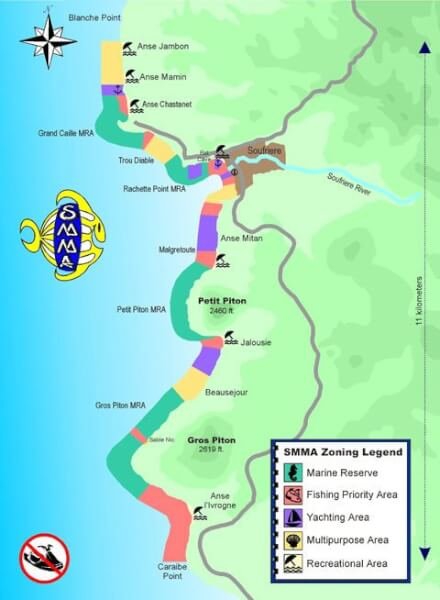
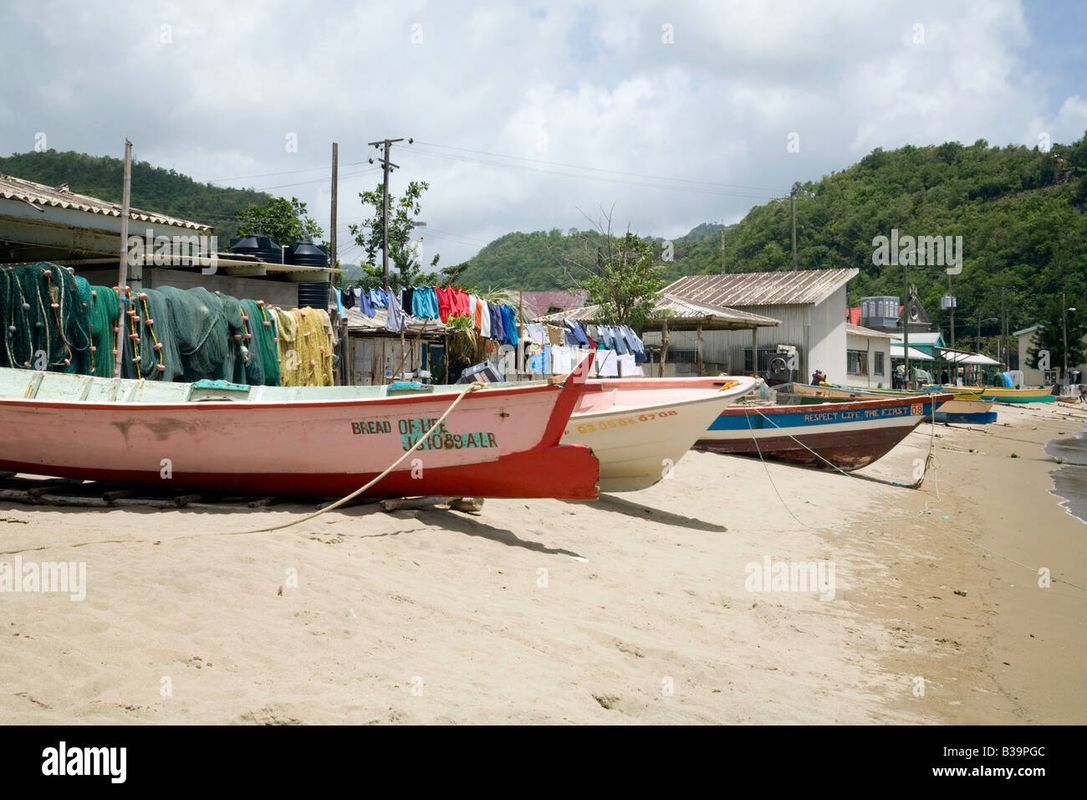
| Metric | Figure |
|---|---|
| Annual landings | ~1,695 tonnes |
| Fishing fleet | ~994 vessels (470 fiberglass pirogues, 356 traditional canoes, 94 transoms, 4 longliners) |
| Fishers | ~2,100 |
| Top catch | Tunas & mackerels (47.5%), dolphinfish/mahi-mahi (33.3%), flying fish (18.2%) |
| Peak season | December – June (pelagics) |
| Lobster season | August – February (high-value tourism market) |
| Landing sites | 8: Gros Islet, Castries, Choiseul, Laborie, Vieux Fort, Soufriere, Micoud, Dennery |
Fisheries Catch by Species
| Species Group | % of Catch | Key Species | Season | Market |
|---|---|---|---|---|
| Tunas & mackerels | 47.5% | Yellowfin tuna, blackfin tuna, king mackerel | Dec–Jun | Domestic, tourism restaurants |
| Dolphinfish (mahi-mahi) | 33.3% | Coryphaena hippurus | Dec–Jun | Domestic, tourism, limited export |
| Flying fish | 18.2% | Hirundichthys affinis | Dec–Jun | Domestic consumption |
| Lobster | ~1% | Spiny lobster (Panulirus argus) | Aug–Feb | High-value tourism / hotel market |
| Other | <1% | Wahoo, barracuda, jacks, conch | Various | Domestic |
The new Daito Complex in Dennery (Japan/Saint Lucia funded) is the island's most modern fish landing facility. Dennery has the highest catch per unit of effort. Choiseul is notable for traditional gommier-tree canoes still used in fishing. The sector is regulated by the Ministry of Agriculture, Fisheries, Food Security and Rural Development with support from CRFM. Lobster season (spiny lobster, Panulirus argus): open August 1 – February 28, closed March–July for breeding protection. Sea urchin (white sea egg) harvesting is also seasonally regulated. The Saint Lucia International Billfish Tournament attracts 130+ anglers annually (target species: blue marlin, white marlin, sailfish, wahoo), and sport fishing is a growing tourism niche with charter boats operating from Rodney Bay Marina and Marigot Bay.
Agritourism Experiences
Agritourism is a growing sector that combines agricultural heritage with tourism revenue, particularly concentrated around Soufriere.
| Attraction | Location | Activities | Pricing (USD) |
|---|---|---|---|
| Hotel Chocolat / Rabot Estate | Soufriere | Tree-to-Bar chocolate tour, Cacao Bar, cocoa grove walk, lunch at Boucan restaurant | $125 (tour + lunch) |
| Fond Doux Eco Resort | Soufriere | Heritage plantation tour, cocoa processing demo, tree-to-bar experience, nature walks | $30–$60 (tour); Heritage Tour: $185/person |
| Morne Coubaril Estate | Soufriere | 18th-century plantation tour, cocoa & copra processing, zipline, horseback riding, cooking class | $11–$110 per activity |
| Diamond Falls Botanical Gardens | Soufriere | 6-acre award-winning gardens, waterfall, mineral baths, tropical plant collection | $10–$15 (garden); mineral bath extra |
| Tet Paul Nature Trail | Soufriere | 45-min guided walk with Piton views, traditional farming plots, medicinal herbs | $10–$25/person |
| Cacoa Sainte Lucie | Canaries | Micro-batch chocolate making, truffle classes, farm excursions | $40–$65 |
| Saint Lucia Distillers | Roseau Valley | Rum distillery tour, tasting experience, production process viewing | $15–$35 |
| Balenbouche Estate | Choiseul | Heritage organic farm, historical ruins, accommodation, cooking experiences | From $95/night; tours by arrangement |
The Saint Lucia Tourism Authority actively promotes the Cocoa Trail and Heritage Plantation experiences. Agritourism provides vital supplemental income for farming communities and creates year-round employment beyond the traditional tourism season.
Climate-Smart Agriculture & Food Security Programmes
| Programme / Initiative | Funder | Focus | Budget / Status |
|---|---|---|---|
| Seven Crops Import Substitution | GoSL | Reduce food imports by 30% in 7 crops; achieve 100% self-sufficiency in 4 crops | Active; Ministry of Agriculture priority |
| BRACCVAS (Building Resilience for Adaptation to Climate Variability & Change in the Agricultural Sector) | Adaptation Fund / CDB | Climate-resilient agricultural practices, infrastructure, farmer training, irrigation systems, soil conservation, post-harvest facilities | US$9.8M grant; active implementation |
| CCRAF on the Road | IICA | Climate-smart farming promotion, youth engagement, community action | 2025 launch in Saint Lucia (CCRAF 10th anniversary) |
| Taiwan Technical Mission | Taiwan (TaiwanICDF) | Drought-resistant banana varieties (Tai-Chiao No. 2), irrigation, agri-tech | Ongoing bilateral programme |
| Bee City Cluster Project | IDB Compete Caribbean | Honey production improvement, export development, beekeeper training | Active since 2019 |
| Darwin Initiative Sea Moss | UK Darwin Initiative | Sustainable sea moss farming frameworks, ecological research | Active |
| CERC-UBEC Livestock | World Bank / GoSL | Resilient animal breed introduction, livestock sector modernisation | 20 breeds imported 2024 |
The government's Sectoral Adaptation Strategy and Action Plan for Agriculture outlines climate resilience priorities including irrigation systems in banana-growing regions, drought-resistant crop varieties, soil conservation, and post-harvest processing infrastructure. Minister Alfred Prospere has prioritised strengthening supply chains, improving agricultural intelligence systems, securing stable markets for farmers, and introducing new farming technologies.
Investment Opportunities
| Opportunity | Rationale | Potential |
|---|---|---|
| Cocoa/chocolate processing | Premium single-origin cocoa (top 9 globally); on-island bean-to-bar factory reduces raw bean export | High margins; $15–30/bar retail |
| Sea moss value-added processing | $5.6M export already; global superfood demand; need for gels, cosmetics, supplements facilities | High growth; US market premium |
| Agro-processing (tropical fruits) | Seasonal surplus of mango, passion fruit, guava; import substitution of juices and preserves | Moderate; leverages Baron Foods model |
| Organic farming (certified) | Volcanic soil naturally suited; growing demand for Caribbean organic produce in NA/EU markets | Premium 30–50% above conventional |
| Hydroponics & CEA | Limited arable land; year-round production; reduces import bill for lettuce, herbs, tomatoes | Moderate; targets hotel/restaurant sector |
| Aquaculture | Underdeveloped sector; growing seafood demand from tourism industry | High potential; tilapia, shrimp viable |
| Coconut revitalisation | 12,400 acres already planted; virgin coconut oil and coconut water for health food markets | Growing ($12B+ global coconut water market) |
| Specialty coffee | Ideal growing conditions; Caribbean single-origin commands premium pricing | High margins; $30–50/lb specialty |
| Agritourism experiences | Farm stays, chocolate tours, cooking classes, heritage plantation experiences | $50–200/visitor; year-round income |
| Poultry expansion | Only self-sufficient in eggs; significant frozen chicken imports; protected domestic market | Moderate; steady domestic demand |
| Honey production & export | Growing global demand; IDB-supported cluster; National Standard SLN 99 established | Moderate; premium Caribbean honey |
| Specialty rum & craft spirits | Boutique production leveraging Saint Lucia's world-class distilling heritage | High margins on premium aged rums |
Incentives: Up to 15-year tax holidays, import duty waivers on machinery/raw materials, export allowances, Free Zone benefits (Vieux Fort), accelerated depreciation. Invest Saint Lucia assists with planning and approvals. The Agricultural and Rural Development Fund provides financing support. Duty-free concessions available for sea moss and apiculture equipment.
Investment Considerations & Challenges
Key Challenges for Agricultural Investors
- Land access: Land lease available for farming; foreign purchasers require an Alien Landholding License
- Water availability: A critical concern — drought conditions and WASCO rationing affect irrigation. 2026 drought concerns elevated. WASCO secured US$22.8M CDB loan for pipeline rehabilitation; desalination plant proposal under consideration. Government prioritising watershed management
- Climate change: Increasingly erratic rainfall patterns affecting growing seasons; tropical storms destroy crops (75% of banana crop lost to Tropical Storm Bret 2024)
- Labour availability: Farm labour supply is challenging as younger workers prefer service-sector jobs
- Praedial larceny: Crop theft is a reported issue, particularly for high-value crops
- Export logistics: Export Saint Lucia / TEPA (Trade Export Promotion Agency) assists with export logistics and market access
The "Taste of Saint Lucia" brand promotes local agricultural products internationally. Hot peppers and cut flowers have emerging export potential. Coconut revitalisation (copra processing, coconut oil, coconut water) is underway across 12,400 acres. Breadfruit has growing international interest as a sustainable food source.
Creative Industries

Saint Lucia has a remarkably rich cultural heritage for its size, being the birthplace of two Nobel laureates: Sir Derek Walcott (Literature, 1992) and Sir W. Arthur Lewis (Economics, 1979). The government actively promotes the creative or "Orange Economy" under the Ministry of Tourism, Investment, Creative Industries, Culture, and Information, recognising the sector's potential for job creation, cultural capital, and tourism enhancement.
Creative Economy Grant Fund (CEGF) — August 2025
The government launched the EC$350,000 Creative Economy Grant Fund in August 2025, administered by the Ministry of Tourism, Investment, Creative Industries, Culture and Information. Micro Grants: up to EC$5,000; Production Grants: EC$5,001–$10,000. Available to artists, musicians, filmmakers, designers, and other creative professionals.
Dennery Segment — Saint Lucia's Global Music Export
Dennery Segment (also known as Lucian Kuduro) is a unique Saint Lucian music genre characterised by 140+ BPM tempos, blending African and Caribbean rhythms. The genre has gained international recognition and is a defining cultural export. Top artists include Ricky T (19 competition wins, 8 Road March titles), Arthur Allain, Teddyson John, Motto, and Freezy. The island's music ecosystem spans calypso, soca, zouk, reggae, and Dennery Segment, with recording facilities including ESP Myoho Studios (Bisee, opened 2020).
Music Industry
Music is central to Saint Lucian identity and is the beating heart of the island's festival economy.
| Genre / Tradition | Description | Key Events |
|---|---|---|
| Soca | Dominant carnival genre. Power Soca and Groovy Soca sub-genres drive the July Carnival season. Emerging artists compete in the Soca Monarch competition | Carnival (July): Soca Monarch finals, J'Ouvert |
| Calypso (Kaiso) | Traditional narrative song form with social commentary. Four calypso tents operate during carnival, including the new SALCC Academia Tent. Calypso Monarch competition is a cultural highlight | Carnival (July): Calypso Monarch finals, Kaiso tents |
| Zouk / Kweyol music | French Creole-influenced music reflecting the island's dual colonial heritage. Zouk and Kadans popular for social dancing | Jounen Kweyol (October), La Rose/La Marguerite festivals |
| Steelpan (Panorama) | Steel drum ensembles compete in Senior and Junior Panorama competitions. Growing school programmes develop young players | Carnival: National Panorama finals |
| Jazz & Contemporary | The Saint Lucia Jazz & Arts Festival (est. 1992) at Pigeon Island National Landmark is the Caribbean's premier jazz festival. 2025 headliners: John Legend, Earth Wind & Fire, Summer Walker, Samara Joy | Late April-early May annually |
Carnival 2025 attracted 24,500 visitor arrivals (a 36% increase over 2024), with additional flights added from Miami and New York. A new School Soca Monarch competition was introduced in 2025 to develop youth talent.
Visual Arts & Traditional Crafts
Saint Lucia has a vibrant visual arts scene rooted in both African and European traditions, with a growing contemporary movement. Notable figures include Eudovic Art Studio (50+ years of wood sculpture, Morne Fortune), Dunstan St Omer (designer of the national flag), and the island's two Nobel laureates — giving Saint Lucia the highest per-capita Nobel laureate count in the world.
- Choiseul Arts & Crafts Centre — The crafting heartland of Saint Lucia. Artisans produce handmade clay pottery, straw goods, wood carvings, and hand-painted jewellery. Exports to USA (Maryland). Operated by the Choiseul Arts, Craft & Tourism Heritage Association
- Batik & textile arts — Locally made batik fabrics available at Howelton Estate near Castries and at Caribelle Batik workshop. Traditional dyeing and printing techniques applied to clothing, wall hangings, and accessories
- Painting & sculpture — A thriving community of painters and sculptors, many concentrated in the Choiseul and Anse la Raye areas. The "Art & The City" programme during Jazz Festival transforms Castries into an open-air gallery with live art, spoken word, and folk performances
- Galleries — Inner Gallery Rodney Heights, Alliance Francaise exhibitions, Llewellyn Xavier studio. Hotel galleries at Anse Chastanet, Jade Mountain, and Cap Maison feature local artists
- Craft markets — Castries Market (300+ vendors: pottery, wood carvings, straw baskets), Rodney Bay craft market (Sunday), Pointe Seraphine vendors, La Place Carenage. The "Taste of Saint Lucia" / Shop Local initiative promotes locally made products
Literature, Theatre & Publishing
Derek Walcott's Legacy
Sir Derek Walcott (1930-2017), Saint Lucia's Nobel Laureate for Literature, produced an extraordinary body of work: over 25 published collections of poetry (including Omeros, a Caribbean reimagining of Homer), more than 10 plays, and founded the Trinidad Theatre Workshop. His work blended Caribbean Creole, English, and West Indian experience into a unique literary voice. Walcott's legacy is celebrated through the annual Nobel Laureate Festival (January).
- Local publishing — Small but active publishing scene. Jako Productions publishes work on Saint Lucian culture, history, and identity
- Theatre — Community theatre groups perform throughout the year. The National Cultural Centre in Castries hosts theatrical productions and cultural performances
- Kweyol literature — Growing body of Creole-language literature, poetry, and oral tradition. Jounen Kweyol (last Sunday of October) celebrates this linguistic heritage
Fashion & Design
- Saint Lucia Fashion Council Inc. (founded 2016) — Organises SFC Style Week, Rags2Riches, and SFC Fashion Awards. Notable designers: FLIPP Designs, Shazi International, Shelniel Swimwear
- Carnival costume design — The Parade of the Bands and King & Queen of the Bands competition drive a significant costume design and manufacturing industry. Mas band leaders commission elaborate creations each year
- Caribbean fashion designers — Local designers showcase collections during Caribbean Fashion Week and regional events
- Resort wear & swimwear — Growing niche for locally designed resort and beachwear catering to the tourism market
- Jewellery & accessories — Handcrafted jewellery using local materials (coconut shell, seeds, clay beads) sold through craft markets and hotel gift shops
Film, Media & Digital Creative Economy
Saint Lucia's dramatic landscapes — the Pitons, rainforests, volcanic springs, colonial architecture, and beaches — make it attractive for film and photography production. Notable productions filmed on the island include Dr. Dolittle (1967), Superman II, and Pirates of the Caribbean (Marigot Bay).
- Film location services — The SLTA issues film permits via the St. Lucia Film Commission. The Fiscal Incentives Act 2020 was expanded to include creative industries, providing tax holidays, duty waivers on equipment, and export allowances for qualifying productions
- Content creation — A growing community of YouTubers, TikTok creators, and social media influencers. Travel content creation is a significant driver of destination marketing
- Digital creative services — Web design, graphic design, digital marketing, and app development. The digital nomad visa ("Live It" programme) attracts international creative professionals
- Music production — Local recording studios produce soca, calypso, and contemporary music. Growing demand for Caribbean sounds in international markets
Cultural Tourism Connection
| Cultural Product | Tourism Impact |
|---|---|
| Jazz & Arts Festival | Peak hotel occupancy (May); international networking event; "Art & The City" gallery trail |
| Lucian Carnival | 24,500 visitors (2025); additional airline capacity; 36% growth over 2024 |
| Jounen Kweyol | Month-long Creole heritage celebration drawing cultural tourists; host community rotation |
| Chocolate Heritage Month | August cocoa farm tours, artisan workshops, resort chocolate-pairing experiences |
| La Rose / La Marguerite | UNESCO-recognised flower society festivals; authentic cultural immersion |
| Festival of Light (Dec 13) | National holiday celebrating Saint Lucia's patron saint; lantern processions |
| Gros Islet Friday Night Street Party | 50+ years running; weekly open-air party, food, and music |
| ARC Rally Arrival (December) | Transatlantic rally prizegiving at Rodney Bay Marina; affluent international visitors |
| Craft markets & galleries | Year-round visitor spending on locally made arts, crafts, and souvenirs |
Creative Spaces & Institutions
- National Cultural Centre (Castries) — Performance venue for theatre, music, and cultural events
- Pigeon Island National Landmark — Open-air waterside concert venue for Jazz Festival; Fort Rodney ruins and interpretive centre
- Alliance Francaise (Castries) — French-Creole cultural centre with exhibition space, library, and event programming
- Choiseul Arts & Crafts Centre — Artisan workshop and retail space for traditional crafts
- Folk Research Centre — Preserves and promotes Saint Lucian folk culture, Kweyol language, and oral traditions
Investment Opportunities
- Festival event management and production services
- Artisan product export (pottery, batik, hot sauces as gift products)
- Digital content and influencer marketing partnerships with Tourism Authority
- Music production studio and recording facilities
- Culinary tourism and cooking experience operators
- Film location scouting and production services
- Creative co-working spaces catering to digital nomads
Renewable Energy
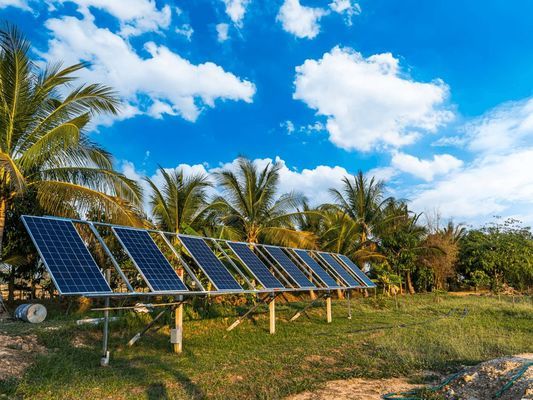
Saint Lucia is heavily dependent on imported diesel for electricity generation, making energy costs among the highest in the Caribbean (~US$0.31–0.33/kWh residential). The government has set ambitious targets for a renewable energy transition, creating significant investment opportunities.
Current Energy Landscape
| Sole Utility | LUCELEC (St. Lucia Electricity Services Ltd) — exclusive license until 2045. Note: Electricity Supply Bill introduced to end generation monopoly; see Regulatory Reform below |
| Installed Capacity | ~93.4 MW total (88.4 MW diesel at Cul de Sac Power Station + ~5 MW solar) |
| Peak Demand | ~61.8 MW (2.6% growth in 2024) |
| Annual Generation | 370–432 GWh (5.6% sales growth in 2024) |
| Customers | 50,000+ |
| Diesel Consumption | ~20.7 million imperial gallons/year for power generation |
| Annual Diesel Import Bill | EC$66.1M (~US$24.5M) for electricity generation alone (2020) |
| Per Capita Consumption | 1,826.5 kWh/year (2021) |
| Distribution Losses | 5.74% (2020) |
| Smart Meters (AMI) | 99.99% coverage; travelling wave fault locator on 66 kV lines (50m accuracy) |
| Residential Tariff | EC$0.86–0.91/kWh (~US$0.31–0.33/kWh) incl. fuel surcharge |
| Commercial Tariff | ~US$0.35–0.37/kWh |
| Voltage/Frequency | 240V / 50Hz (UK-style plugs, Type G) |
LUCELEC is publicly traded on the ECSE. Major shareholders: Emera (~20%), First Citizens (~20%), NIC (~20%), Castries Constituency Council (~15.5%), Government (~10%). Ernst & Young appointed as new auditor from January 2025.
NDC 3.0 National Targets
Saint Lucia was the first Caribbean nation to submit its NDC 3.0 to the UNFCCC (February 2025).
| Target | 2030 | 2035 |
|---|---|---|
| Renewable Energy Penetration | 40% (solar, wind, battery storage) | 46% unconditional; higher with geothermal |
| Energy Sector Emission Reduction | 14.7% vs 2010 baseline | 22% unconditional; 32% conditional on geothermal |
The National Energy Policy 2023–2030 sets broader targets: 50% renewable energy by 2030 (aspirational), 33% hybrid/EV penetration by 2030, and 100% renewable energy by 2050. The National Energy Transition Strategy (NETS), developed with Rocky Mountain Institute (RMI), identifies a portfolio of solar, wind, and energy storage as the least-cost pathway, projected to deliver 10% rate relief to customers within 20 years and 11% cumulative energy efficiency savings. Eliminating fossil fuel subsidies could save EC$3.77 billion by 2050, reduce emissions by 16.4%, and increase GDP by 1.9%.
Total Investment Required (NDC 3.0): US$509 Million
| Solar, Wind, Battery Storage, Efficiency, EVs | US$247 million |
| Geothermal (30 MW proven + 140 MW potential) | US$178 million |
| Grid Modernization | US$84 million |
| Total | US$509 million |
Geothermal Energy
Saint Lucia's volcanic geology (Qualibou caldera, Soufriere Volcanic Centre) offers significant geothermal potential, estimated at 170–680 MW. Historical exploration wells (1970s–80s) drilled to 1,413m and 2,213m at Sulphur Springs recorded well-bottom temperatures of 270–290°C in a vapor-dominated reservoir at ~292°C. NDC 3.0 plans for a 30 MW plant (proven) as the base case, with up to 140 MW potential, which would increase renewable penetration to 75%+. The three RESDP drill sites at Belvedere, Belle Plaine, and Upper Saltibus are located away from the Sulphur Springs/UNESCO heritage site.
RESDP — Resilient Energy Sector Development Project
A US$21.85 million flagship geothermal exploration programme (2022–2026):
| Clean Technology Fund (CIF) contingent recovery grant | US$8.57M |
| UK FCDO grant | US$4.20M |
| World Bank IDA credit | US$3.83M |
| Canada Clean Energy & Forest Climate Facility | US$3.70M |
| Government of Saint Lucia (land acquisition) | US$1.00M |
| Gender Trust Fund grant | US$0.55M |
- 3 exploration wells (~2,000m deep each) at Belvedere/Fond St. Jacques, Belle Plaine, and Upper Saltibus/A La Cle (NOT at Sulphur Springs/UNESCO site)
- Technical partner: ELC Electroconsult SpA (Milan, Italy)
- ESIA completed and approved December 2024; land acquired November 2024
- Civil & drilling works contracted January 2025
- World Bank launched Early Market Engagement (EME) for Integrated Drilling Services procurement on January 7, 2026
- Status (Feb 2026): Drilling procurement underway (January 2026). No actual drilling has commenced yet—the project remains in the procurement and preparation phase
- Target: All 3 wells drilled and tested by May–June 2026; timeline described as "very tight"; potential 30 MW (proven) + 140 MW
Key milestones: Exploration Management Company contracted (Jun 2023) → DCA approval (Apr 2024) → Land acquired (Nov 2024) → ESIA completed (Dec 2024) → Civil & drilling works contracted (Jan 2025) → EME for Integrated Drilling Services (Jan 7, 2026) → Drilling procurement (Jan 2026) → Wells drilled & tested (target May–Jun 2026). RESDP is now in its final phase. Also includes legislative/regulatory modernization, direct-use applications study (agro-processing, spa/wellness), and a Scholarship & Apprenticeship Programme for capacity building.
Solar Energy
Saint Lucia enjoys excellent solar irradiance at 14°N latitude: ~12 hours of daylight, ~2,880 sunshine hours/year, and 5.0–5.5 kWh/m²/day GHI. Solar could replace up to 41% of current fossil fuel generation.
| Current Installed Solar | ~5 MW (3 MW Vieux Fort Solar Farm + ~1.67 MW distributed rooftop) |
| La Tourney Solar Farm | 3 MW (AC) / 3.95 MW (DC), 15,000 panels, ~20 acres, ~7 GWh/year. EPC: GRUPOTEC; technical support: Clinton Climate Initiative, RMI, DNV GL. Total cost: ~US$20M. Commissioned April 2018. Levelized cost under US$0.105/kWh—cheaper than diesel. 80% local labor. 758 rooftop solar homes by Mar 2024. |
| Net Metering | Available for residential, commercial & institutional. Bi-directional meter, bill credits for excess generation |
Approved: 10 MW Solar + 13 MW/26 MWh Battery Storage
LUCELEC's most significant near-term project has been approved: a 10 MWac utility-scale solar facility paired with 13.3 MW / 26.6 MWh lithium-ion BESS (2-hour duration) at Troumassee, Micoud (70 acres), connecting to LUCELEC's 66 kV transmission grid via new substation. Owner's Engineer: Hatch Ltd. (Canada). RFP issued November 2025. Construction targeted for Q1 2026. This project will approximately triple Saint Lucia's installed solar capacity.
Wind Energy
Saint Lucia lies in the path of north-easterly trade winds with average speeds of 7.5 m/s—good for wind power. However, the island currently has zero installed wind capacity. The only attempted project, the 12 MW Dennery Wind Farm at Anse Cannot (WindTex Energy, US), had wind assessment tests in 2015 and a PPA signed in 2016, but was cancelled after the developer withdrew. Challenges include hurricane risk requiring Category 5-rated turbines and limited suitable sites. Wind remains part of NDC 3.0 targets; onshore wind+BESS is projected to become cheaper than fossil fuels by 2027, but no active procurement has been announced.
Electric Vehicles & Charging
LUCELEC operates 4 EV charging stations across the island (operational), accessible via the Flash Charge mobile app. The STEM-SLU project is deploying 20 government EVs as a public-sector pilot. The National Energy Policy targets 33% hybrid/EV penetration by 2030. The EV Lucian 2025 Expo was held in 2025 to promote electric vehicle adoption and showcase available models on-island.
Climate Change Act 2024
The Climate Change Act 2024 is landmark legislation establishing a legal framework for climate action in Saint Lucia, including emissions reduction targets, adaptation planning, and institutional coordination. It reinforces NDC 3.0 commitments and provides a statutory basis for the energy transition.
Regulatory Reform: Electricity Supply Bill
Major Regulatory Shift: Ending LUCELEC's Generation Monopoly
The Electricity Supply Bill, introduced to Parliament, aims to end LUCELEC's monopoly on electricity generation—the most significant energy sector regulatory change in decades. The bill would formally allow Independent Power Producers (IPPs) to receive licenses from NURC to generate renewable electricity, while LUCELEC retains its distribution monopoly only. This opens the door for private investment in solar, wind, and geothermal power generation.
The National Utilities Regulatory Commission (NURC), established in 2016, is the independent regulator with authority over licensing, tariff setting, service standards, and consumer affairs. NURC can require LUCELEC to enter PPAs with IPPs. Currently, no formal IPP licenses exist. The draft revised Electricity Supply Act was presented in Parliament in April 2025, then deferred in August 2025 for further stakeholder review (the government "proceeded cautiously" amid the renewable energy push). NDC 3.0 targets: 40% renewable electricity by 2030, 46% by 2035. The SLHTA has called for the Act to enshrine RE targets, include EV integration rules, and mandate smart grid modernization. Electricity demand is projected to grow at 1.8% annually, potentially reaching 525 GWh by 2038.
Investor Incentives
- Import duty exemptions on solar panels, inverters, and energy-saving equipment (since 1999)
- Potential VAT exemptions on solar PV systems
- Tax holidays up to 15 years under the Fiscal Incentives Act for approved enterprises
- Duty-free import of plant and machinery
- No restrictions on foreign ownership of businesses
- Tax deductions for solar water heaters (since 2001)
Caribbean Renewable Energy Comparison
| Country | RE Share | Electricity Cost (US$/kWh) | Target |
|---|---|---|---|
| Dominica | ~25% (hydro) | ~$0.30 | 100% RE; 10 MW geothermal at Laudat (~$68M, CDB GeoSmart) |
| St. Vincent & Grenadines | ~17% (hydro) | ~$0.32 | — |
| Barbados | ~15% (solar, 117+ MW installed, 85% decentralized rooftop) | ~$0.33 | 100% RE by 2035 |
| St. Kitts & Nevis | ~5% | ~$0.33 | — |
| Saint Lucia | ~3% | $0.31–0.33 | 40% by 2030, 46% by 2035 |
| Antigua & Barbuda | ~4% | ~$0.37 | — |
| Grenada | ~4% | ~$0.36 | — |
| Jamaica | ~12% | ~$0.28 | 30% RE by 2030 |
Six OECS nations have an estimated 6,290 MW of combined geothermal resources—far exceeding regional needs. The Basseterre Declaration launched the “Decade of Action for Sustainable Energy Development” (2025–2035). OECS is conducting a feasibility study on a shared geothermal drill rig to reduce exploration costs across member states.
Sources: NDC 3.0 (UNFCCC, Feb 2025), World Bank, LUCELEC Annual Report 2024, RMI, NREL, OECS, CARILEC, Climate Change Act 2024. Data as of early 2026.
Technology & BPO

The government is actively promoting Saint Lucia as a destination for technology companies and business process outsourcing (BPO) operations. BPO was the largest job creator in 2020 (50%+ of all new jobs), with 20% sector growth in 2019 and 40% job growth in 2021. Invest Saint Lucia 2024 results: 1,865 jobs created and $989.36M investment inflow. BPO is one of Invest Saint Lucia's 5 priority projects for 2025.
BPO Industry
| Operator | Focus | Notes |
|---|---|---|
| KM2 Solutions | Contact centres, BPO | HQ in Saint Lucia (founded 2004). 12 sites, 6 countries, 5,000+ agents, 40+ Fortune 500 clients. New 40,000 ft² facility at Orange Grove Plaza (Aug 2025, 850 workstations). +300 new jobs added, potential 1,000 total new positions. Total SLU capacity: 2,500. |
| itel | Customer experience | Major Caribbean BPO with Saint Lucia presence. |
| Ascension BPM | Finance & accounting, HR | Knowledge process outsourcing (KPO) focus. |
| OJO Labs | Real estate tech | US company with Saint Lucia operations. |
| 1888 Go Answer | Answering services | Call centre operations. |
Investment-ready BPO locations: Anse Canot (Dennery), Bisee (Castries), Cantonment (Vieux Fort). Contact: Invest Saint Lucia. Workforce advantages: most tertiary-educated workforce in the OECS, neutral English accent valued by US clients, strong North American cultural affinity. The Fiscal Incentives Act 2020 amendment added ICT/BPO as an eligible industry for tax holidays.
Franchise & Retail Landscape
Saint Lucia has a limited but growing franchise and retail sector, with significant room for new entrants. The growing middle class and tourism sector create demand for familiar international brands.
| Brand / Chain | Locations | Type |
|---|---|---|
| KFC | 4 locations island-wide | Fast food |
| Subway | Multiple locations | Fast food |
| Domino's Pizza | Present | Fast food |
| Massy Stores | 13 locations | Supermarket (largest retailer, regional chain) |
| Courts | Present | Furniture & electronics |
| Digicel / FLOW | Multiple locations | Telecom retail |
Franchise & Retail Opportunities
- No major coffee chain (no Starbucks) — specialty coffee franchise opportunity
- Limited gym/fitness franchises — growing health-conscious population and tourist demand
- Fast food competition limited — room for new brands beyond KFC/Subway/Domino's
- Tourism-driven demand for familiar international retail brands
Regulatory: Foreign franchise operators need work permits for key personnel. Alien Landholding License required if purchasing property. Trade license required from Ministry of Commerce. Import duties on supplies/inventory unless under an incentive agreement.
Services & Opportunities
- BPO: Call centres, customer service, answering services, back-office processing
- KPO: Financial technology, legal services, advanced analytics, AI/web services, medical services
- ICT: Web/mobile development, image processing, software development
- E-commerce: Caribbean market platforms (Shopfront, Order Shop, Massy Stores online)
- Fintech: Digital payment solutions, DCash ecosystem
- EdTech: Remote learning platforms, digital skills training
🌐 Digital Infrastructure & Connectivity
Saint Lucia's digital connectivity is underpinned by submarine fibre-optic cables and a growing broadband network. Key infrastructure includes:
- Submarine Cable Network — Connected via the Southern Caribbean Fiber (SCF) system (rebranded Deep Blue 1 in 2024), a ~3,000 km cable linking 15 Eastern Caribbean islands with 16 landing points. Fibre-optic links run to Martinique, St. Vincent & the Grenadines, and Barbados.
- CARCIP Undersea Cable — A World Bank-funded undersea cable system connecting Grenada, Saint Lucia, and St. Vincent & the Grenadines, boosting regional broadband capacity and service quality.
- Deep Blue Cable & SubCom Partnership — A new subsea fibre-optic cable project connecting multiple Caribbean markets directly to the United States, improving latency and redundancy for businesses and data centers.
- Mobile Networks — 204,000 active cellular connections (113% of population). Major providers: Digicel and Flow (Liberty Latin America). 4G/LTE coverage across the island.
- Fixed Broadband — Approximately 24,000+ fixed broadband subscriptions (~14% of the population with dedicated fast broadband >256 kbit/s). Average measured speed: 91.4 Mbps. Digicel offers up to 1 Gbps FTTH. The government's Broadband Policy & Strategy (developed under the CARDTP) aims for universal broadband access by ~2028.
- Starlink — Available since late 2024. LEO satellite broadband (50-150 Mbps download). ~US$80/month + US$350-600 equipment. Particularly useful for rural areas with weak terrestrial coverage.
- GINet Public Wi-Fi — Government Island-Wide Network: 28 free Wi-Fi hotspots deployed in Soufriere (Phase 1); Phase 2 added hotspots across 27 locations in six districts.
Caribbean Digital Transformation Project (CARDTP)
Saint Lucia participates in the US$94 million World Bank-funded Caribbean Digital Transformation Project (approved June 2020), building on the success of the earlier CARCIP programme. The CARDTP aims to increase access to digital services, technologies, and skills for governments, businesses, and individuals across four Eastern Caribbean nations (Dominica, Grenada, Saint Lucia, St. Vincent & the Grenadines). Through the project, 20 smart classrooms have been equipped across Saint Lucia's eight educational districts, with 35 trained teachers benefiting over 4,500 primary school students. The programme also supports government ICT standards development and national digital policy frameworks.
🏛 E-Government & Digital Services
Saint Lucia is modernizing public service delivery through its national digital government platform and related initiatives:
- DigiGov Platform — The Digital Government Integrated e-Services portal (digigov.govt.lc) delivers 154 government services across 8 ministries online, including birth certificate applications, vehicle e-services, and company registration. The platform supports electronic payment for government services.
- e-Land Registry System — An electronic land registry implemented in partnership with the Department of Physical Development under the CARDTP, enabling digital land record management and property searches.
- Online Business Registration — The Registry of Companies and Intellectual Property (ROCIP) offers online business name searches and registration. The IBC Pinnacle Registry provides a fully online system for International Business Company incorporation with instant notification upon registration.
- Inland Revenue e-Services — The Inland Revenue Department provides online tax filing and payment portals for individuals and businesses.
- CBI Digital Processing — In 2025, Saint Lucia digitalized its Citizenship by Investment application processing, significantly reducing turnaround times for prospective applicants.
- National ICT Standards — Under the CARDTP, the government is developing comprehensive Government ICT Standards and National Digital Policies to guide digital governance across all ministries.
💳 Fintech & Digital Payments
A growing fintech ecosystem is emerging in Saint Lucia, supported by the ECCB's digital currency initiative and local startups:
- DCash (CBDC) — Saint Lucia is a pilot country for the ECCB's DCash digital currency, launched March 2021. Adopted by 21 financial institutions and 400+ businesses before a service interruption in January 2024 due to technical issues. DCash 2.0 is under development (RFI Dec 2023, stakeholder rounds Q2-Q3 2024) with anticipated launch in 2026. Three wallet types: Registered, Value-Based, and Merchant.
- Penny Pinch Inc. — An award-winning Saint Lucia-based fintech startup offering a mobile digital wallet with cashback rewards and merchant discounts. Licensed under the Money Services Business Act and regulated by the Financial Services Regulatory Authority (FSRA). Partnered with 1st National Bank and Digicel.
- Growing Fintech Sector — Approximately 59 fintech startups registered in Saint Lucia (per Tracxn), spanning digital banking, blockchain, payment processing, and trading platforms including Sway Funded, Squeeze Cash, and One Ring Finance.
- Regulatory Framework — The Financial Services Regulatory Authority (FSRA) provides oversight for fintech operations, money services businesses, and digital financial services, fostering a trusted environment for innovation.
🏝 Digital Nomad Visa — "Live It" Program
Saint Lucia offers the "Don't Just Visit, Live It" digital nomad visa program (launched 2021), allowing remote workers, freelancers, and students to live and work on the island for up to one year.
| Detail | Information |
|---|---|
| Eligibility | Remote workers, freelancers, or students with income/enrollment from outside Saint Lucia |
| Duration | Up to 12 months (renewable) |
| Visa Fee | Single entry: XCD 125 (~US$47) • Multiple entry: XCD 190 (~US$70) |
| Income Requirement | No official minimum income threshold; must demonstrate sufficient funds for stay |
| Tax Status | No local income tax on foreign-sourced earnings; cannot take local employment |
| Application | Online application; typically approved within 5 business days |
| Living Costs | ~US$1,500–$2,500/month (single) • ~US$2,500–$4,000/month (family of 4) |
🚀 Startup Ecosystem & Incubators
Saint Lucia's startup ecosystem is developing with government and institutional support, with strengths in energy/environment, software, and data sectors:
- BOOST Saint Lucia — A virtual incubator and accelerator programme (launched September 2021) supporting entrepreneurial businesses through innovation, education, and mentorship.
- ICT Business Incubator — Provides shared workspace and mentorship for technology startups in Saint Lucia.
- Saint Lucia Youth Business Trust (SLYBT) — Non-profit (est. 2011) empowering entrepreneurs aged 18–35 with training, mentorship, accessible financing, and business development support.
- Youth Economy Agency (YEA) — Government agency that partnered with TPIsoftware and TaiwanICDF in 2025 to launch an e-commerce platform supporting youth and women entrepreneurship.
- National Competitiveness & Productivity Council (NCPC) — Facilitates hackathons, tech bootcamps, and incubator programs while providing business counseling, training, and networking opportunities.
- Startup Huddle St. Lucia — Regular peer-to-peer meetups where entrepreneurs share challenges and receive community feedback and mentoring.
🔒 Data Protection & Cybersecurity
Saint Lucia has a legal framework for data protection and electronic transactions relevant to tech businesses:
- Data Protection Act (2011), amended 2014 — Covers data controller obligations, registration, data subject rights (access, rectification, erasure, opt-out). Penalties: up to EC$10,000 (individuals) / EC$100,000 (corporations). Aligned with EU GDPR-like standards.
- Electronic Transactions Act — Legal recognition for electronic contracts and digital signatures.
- Electronic Crimes Bill — Drafted to prevent cybercrime and enable electronic evidence collection (Budapest Convention aligned).
- Regulators: NTRC (ntrcslu.lc) for telecom; ECTEL for regional coordination; FSRA for financial services.
Construction & Real Estate Development

The construction sector experienced a remarkable rebound in 2024, driven by both public infrastructure spending (EC$247.2M, +52.3%) and private hotel/resort development. The IMF identified construction as a key economic driver alongside tourism. Construction costs increased ~14% year-over-year (compared to a Caribbean average of ~19%).
Major Projects
| Project | Details | Value / Status |
|---|---|---|
| A'ILA Resorts & Residences | Mixed-use luxury: 320-room hotel, 153-room family hotel, 312 residences, 90 villas, spa, 21 restaurants | US$1.3 billion; Phase 1 opened 2025 |
| Hewanorra Airport Redevelopment | New 337,000 ft² terminal, 100+ ft ATC tower, 5 new aprons with air bridges | US$175 million; completion 2029 |
| Castries Cruise Port Expansion | Berth expansion for mega-ships; target 1M+ annual cruise visitors. Demolition and reconstruction underway. | US$135 million (GPH); Oct 2026 completion target |
| Public infrastructure | Road rehabilitation, water infrastructure projects | EC$600M pipeline through 2026 |
| WASCO Water Pipeline Rehabilitation | Island-wide pipeline rehabilitation to reduce losses and improve supply reliability | US$22.8M CDB loan approved |
Water Infrastructure & Supply
Water Supply Challenges (2026)
WASCO (Water & Sewerage Company) secured a US$22.8 million CDB pipeline rehabilitation loan to address chronic water distribution losses and improve supply reliability across the island. A desalination plant proposal is under active consideration to provide drought-resilient water supply. 2026 drought concerns remain elevated, with potential water rationing advisories. Businesses should plan for water supply disruptions and consider rainwater harvesting and on-site storage.
DCA Permit Process
All construction requires DCA approval under the Physical Planning and Development Act. Approval takes approximately 42 days (6 weeks). See the Environmental & Planning Regulations section on the Legal page for full details.
Building Materials & Labour
- Import dependency: High (estimated 60-80%+). Steel, cement, lumber, and specialized materials imported. Local production: concrete blocks (Wilrock Ltd), aggregate, ready-mix (C.O. Williams)
- Standard residential: XCD $300/ft² (~US$111/ft²); luxury: up to XCD $450/ft² (~US$167/ft²)
- Skilled labour: XCD $150–200/day. Unskilled labor available, but skilled tradespeople in limited supply. TVET system expanding (4 schools converted to TVET in August 2024)
- OECS Building Code: 150 mph wind resistance required (Category 4/5 hurricane standards)
- DCA updated Land Development Regulations November 2024, effective 2025—enhanced disaster resilience and sustainable construction provisions mandatory
VAT Waiver on Building Materials
12.5% VAT waiver on plywood, lumber, cement, steel, galvanize, and solar PV systems. Originally enacted August 2023, extended to May 2026. This was a significant contributor to the 22.4% construction growth in 2024. Tourism projects qualify for additional duty-free material imports and up to 15-year tax holidays.
Mining & Quarrying
Saint Lucia has no formal mining industry — the extractive sector is limited to quarrying of volcanic rock (basalt) for construction materials. Natural resources rents represent just 0.011% of GDP (2019). The sector employed approximately 121 people as of the last census, though this figure has likely grown with the post-2021 construction boom.
Major Quarry Operators
| Operator | Est. | Products | Notes |
|---|---|---|---|
| Wilrock Ltd | 1992 | Screened aggregates, concrete blocks, ready-mix concrete, filter stone, armor rock | Market leader. Saphyr Estate, Laborie. 75-ton block plant. Exports to Trinidad & Tobago, Guyana, Barbados, USVI |
| Quarry Products Ltd | 1986 | Quarry operations, masonry blocks | One of the original operators |
| Concrete & Aggregates Ltd (C.O. Williams) | — | Ready-mix concrete, asphalt | Regional construction conglomerate |
| C'Bbean Pastoosh Ltd | Jul 2024 | High-quality grey products | Only provider of premium grey products on-island |
Regulation & Environmental Compliance
| Physical Planning & Development Act 2001 | Quarrying permits required from the DCA |
| Beach Protection Act | Sand/gravel extraction from beaches prohibited without permit (max 3 months) |
| Wildlife Protection Act | Fines up to XCD$5,000 for habitat damage |
| EIA Requirement | Environmental Impact Assessment required for significant quarrying developments |
| Enforcement | SLEPA (Saint Lucia Environmental Protection Agency) oversees environmental compliance |
Sand Mining Issues
Illegal beach sand mining at Grande Anse has damaged endangered Saint Lucia iguana nesting sites. Twenty marine reserves are under constant threat from unauthorised extraction. The industry is shifting to manufactured sand and crushed aggregates as sustainable alternatives to beach sand.
Volcanic/Mineral Resources
- Pumice deposits: Choiseul and Belfond deposits (1–100+ metres thick), limited extraction
- Sulphur Springs minerals: Kaolinite, quartz, gypsum, alunite, pyrite present at the volcanic site. Historical sulphur mining: 540 tonnes exported in 1836
- Geothermal reserves: 30 MW proven; potential 170 MW total (see Renewable Energy section)
- Sulphur Springs tourism: ~200,000 annual visitors to the drive-in volcano
Construction Materials Trade
| Exports | Aggregates and armor rock to Caribbean markets (Wilrock). Gravel & crushed stone exports: ~US$5.7M |
| Cement | 100% imported (no local production). Portland cement imports: US$8.51M (2020) |
| Construction FDI | $3B+ in confirmed construction-related FDI since July 2021 |
| Building material | Primary material: basalt (volcanic rock). Products: screened aggregates, concrete blocks, ready-mix, filter stone |
The construction boom driven by hotel projects (A'ILA, Secrets, Cabot, etc.) and public infrastructure (Hewanorra, Port Castries) has significantly increased demand for locally quarried materials. The VAT waiver on building materials (extended to May 2026) further stimulates demand.
Cannabis & Hemp (Emerging)
Saint Lucia decriminalized the possession of small amounts of cannabis in September 2021 through amendments to the Drugs Prevention of Misuse Act, making it one of the more progressive Caribbean nations on this issue. The Cannabis and Industrial Hemp Bill 2025 was unveiled for public comment in January 2025 but has not yet been enacted. A full commercial licensing framework is still under development.
Current Status
| Decriminalization | Possession of up to 30 grams for personal use is decriminalized (no criminal charge; possible civil fine) |
| Home cultivation | Growing up to 4 plants per household is permitted |
| Cannabis Commission | Established July 2019 to review laws and recommend reform; Cannabis and Industrial Hemp Bill 2025 published for public comment but not yet enacted |
| Medical cannabis | Legislation anticipated but not yet enacted as of early 2026 |
| Recreational sales | Not yet legal; no dispensary or retail framework |
| Hemp/CBD | Regulatory framework under development |
| Export | Not currently permitted |
Investor Caution
While decriminalization signals intent, the commercial cannabis industry in Saint Lucia is pre-licensing. No cultivation, processing, or sales licenses have been issued. Investors should monitor developments from the Cannabis Commission and the Attorney General's Chambers. Banking for cannabis-related businesses remains extremely challenging due to US correspondent banking relationships.
Regional Comparison
| Country | Status |
|---|---|
| Jamaica | Most advanced: Cannabis Licensing Authority (CLA); medical, therapeutic, and sacramental licenses issued. Decriminalized 2015. |
| Antigua & Barbuda | Decriminalized (15g); Cannabis Commission established; Rastafarian sacramental use permitted. |
| Trinidad & Tobago | Decriminalized (30g); home cultivation (4 plants); Cannabis Licensing Authority established 2023. |
| Saint Lucia | Decriminalized (30g); home cultivation (4 plants); Commission established; no commercial licenses yet. |
Maritime Services

Saint Lucia's strategic position in the Windward Islands, its deep-water harbours, and world-class marina infrastructure make maritime services one of the island's most promising growth sectors. Located on major Caribbean shipping lanes, less than 150 nautical miles from Barbados, Martinique, Antigua, and St. Vincent, the island serves as both a yachting destination and a regional maritime hub. The government's Blue Economy agenda — endorsed through Cabinet Conclusion No. 457 of 2024 with the adoption of a National Coastal and Marine Spatial Plan — signals a strategic pivot toward sustainable ocean-based economic development.
SLASPA — Saint Lucia Air and Sea Ports Authority
National Port Authority
SLASPA (established 1983 under the Air and Sea Ports Authority Act) is the statutory body responsible for managing, operating, and developing all air and sea port facilities in Saint Lucia. SLASPA oversees both Hewanorra International Airport (UVF) and George F.L. Charles Airport (SLU), as well as Port Castries, Vieux Fort Port, and all maritime administration functions including the ship registry and Division of Maritime Affairs (DMA).
| Established | 1983 (Air and Sea Ports Authority Act) |
| Headquarters | Manoel Street, Castries |
| Mandate | Manage, maintain, develop and operate air and sea port facilities; regulate maritime affairs; manage ship registry |
| Sea Ports | Port Castries (primary cargo/cruise), Vieux Fort Port (secondary cargo), cruise terminals at Pointe Seraphine & La Place Carenage |
| Airports | Hewanorra International (UVF) — under US$157M expansion by JICA; George F.L. Charles (SLU) — inter-island |
| Key Divisions | Port Operations, Airport Operations, Division of Maritime Affairs (DMA), Finance & Administration, Engineering |
| Cruise Concession | Global Ports Holding (GPH) — 30-year concession from May 2024 for cruise port operations and US$135M redevelopment |
| Revenue Sources | Port dues, wharfage, pilotage, dockage, storage, passenger head tax ($2.50 government share per cruise passenger), airport fees |
| Contact | +1 (758) 452-2893 | info@slaspa.com | slaspa.com |
Port Castries Redevelopment Programme
US$135M GPH Port Transformation (2024–2026)
Global Ports Holding (GPH), the world's largest independent cruise port operator, commenced a US$135 million (~EC$365M) redevelopment of Port Castries under a 30-year concession agreement signed in May 2024. This is one of the largest single infrastructure investments in Saint Lucia's history. Demolition and reconstruction began in January 2025, with a target completion of October 2026.
| Component | Details | Status |
|---|---|---|
| Berth expansion | New dolphin berth and pier reinforcement to accommodate Icon/Oasis-class mega-ships (6,500+ passengers, 250,000+ GT) | Under construction |
| Pointe Seraphine | Terminal modernisation, expanded duty-free shopping (25+ shops), new passenger processing facilities | Ongoing upgrades |
| Boardwalk | New pedestrian boardwalk connecting cruise terminals to downtown Castries commercial district | Planned |
| Vendors Arcade | Purpose-built covered vendors market at Pointe Seraphine for local artisans and craft sellers | Under construction |
| Fishermen's Village | New waterfront facility at Bananes Bay for local fishermen, restaurants, and cultural experiences | Planned |
| Soufriere tender port | Waterfront revitalisation for cruise ship tender operations at Soufriere | Planned |
| Simultaneous capacity | Target: 5 ships simultaneously on peak days (up from 3–4 currently) | By completion 2026 |
| Annual target | 1 million+ cruise passengers per year post-completion | 2027 onward |
Cruise Industry Performance
| Season | Passengers | Ship Calls | Key Notes |
|---|---|---|---|
| 2018–19 | 798,176 | ~350 | Pre-COVID record season |
| 2020–21 | ~93,610 | — | COVID shutdown; phased restart |
| 2022–23 | 614,980 | 264 | Strong recovery; multiple cruise lines resumed |
| 2024–25 (record) | 823,132 | 459 | New all-time record; 17.6% YoY growth |
| 2025–26 (target) | 750,000 | — | Reduced due to port construction disruptions |
| Post-2027 (target) | 1,000,000+ | — | Following GPH port expansion completion |
Cruise tourism expenditure (2024): US$72.7 million (FCCA). Average passenger shore spend: US$104.36. Peak month: December 2024 (135,000 passengers on 62 ships). 20+ cruise lines call at Saint Lucia, including Royal Caribbean, Carnival, Celebrity, MSC, Norwegian, Holland America, Disney, Windstar, Seabourn, and Silversea. Head tax: $12.50/passenger ($2.50 to government, $10 to GPH under concession).
Shipping Lines & Logistics
| Shipping Line | Services | Frequency |
|---|---|---|
| Tropical Shipping (Saltchuk) | Container & break-bulk from Miami, Jacksonville, Port Everglades | Weekly sailings |
| CMA CGM | Major container line; Europe & Caribbean feeder services | Regular schedule |
| Geest Line | UK – Eastern Caribbean services (historic banana trade route); Reefer & container | Bi-weekly |
| Maersk / Hamburg Süd | Global container shipping; transshipment via hub ports (Kingston, Freeport) | Via feeder connections |
| MSC | Caribbean containerised services | Regular schedule |
| King Ocean Services | RoRo and container services from Port Everglades | Weekly |
| Bernuth Lines / Hyde Shipping | Regional break-bulk and project cargo | As scheduled |
| Route | Transit Time | Service |
|---|---|---|
| Miami / Fort Lauderdale → Port Castries | 4–6 days | Primary US import route (Tropical Shipping, King Ocean) |
| Jacksonville → Port Castries | 5–7 days | Container & break-bulk |
| UK (Tilbury/Portsmouth) → Port Castries | 14–18 days | Geest Line; container & reefer |
| Trinidad & Tobago → Port Castries | 1–2 days | Regional feeder; major T&T imports (food, fuel, building materials) |
| Barbados → Port Castries | 12–18 hours | Inter-island cargo & ferry service |
| Martinique → Port Castries | 4–6 hours | Express cargo; passenger ferry (L'Express des Iles) |
Saint Lucia's trade is heavily import-dependent: total merchandise imports ~US$820M vs exports ~US$53.5M (trade deficit ~US$465M). Container throughput at Port Castries: approximately 150,000 TEU/year. Vieux Fort handles overflow cargo and transshipment (~50,000 TEU/year capacity). All customs clearance is processed through the ASYCUDA World electronic customs system operated by the Customs and Excise Department. Free Zone companies at Vieux Fort benefit from streamlined customs procedures and duty exemptions on imported raw materials.
Marina Infrastructure
| Marina | Capacity | Max Vessel | Key Facilities |
|---|---|---|---|
| IGY Rodney Bay Marina | 253 slips + 120 dry dock | 285 ft LOA | Full-service 4.5-acre boatyard, 75-ton travel lift, fuel dock, chandlery, customs & immigration clearance on-site, provisioning, free Wi-Fi. Host venue for ARC rally finish. Managed by Island Global Yachting (IGY Marinas). |
| Marigot Bay Yacht Haven (Capella Marina) | 42 berths + 20 moorings | 280 ft LOA, 20 ft draft | Deep-water protected cove, 70-ton mooring buoys, fuel, water, electricity, resort amenities. Favourite yacht charter base-point. Hurricane hole reputation with excellent natural shelter. |
| Soufriere Marine Management Area (SMMA) | 60 yacht moorings | Varies by zone | Managed mooring field in the Pitons UNESCO zone. Scuba dive/snorkel permits. ~3,600 yachts and 5,000 boats annually; 21,000+ snorkelers, 12,000+ divers per year. |
SMMA mooring fees: vessels up to 70 ft — EC$54/US$20 per night (EC$324/US$120 per week); 70-120 ft — EC$270/US$100 per night; 120 ft+ — EC$540/US$200 per day. Crewed charters: EC$1,350/US$500 per annum.
Atlantic Rally for Cruisers (ARC)

The ARC (organized by World Cruising Club, UK) is the world's largest transatlantic sailing rally, finishing at IGY Rodney Bay Marina each December since 1986. The ARC is co-sponsored by the Saint Lucia Tourism Authority and IGY Rodney Bay Marina.
| Route | Las Palmas de Gran Canaria to Rodney Bay (~2,700 nautical miles) |
| Duration | Departs late November; fleet arrives ~Dec 10-21 (14-21 day crossing) |
| Fleet Size (annual) | ~150-200+ yachts across ARC and ARC+ divisions |
| Crew | ~1,200+ crew members per edition |
| Cumulative Totals (1986-2025) | Over 8,000 boats and 40,000 sailors across 40 editions |
| 2024 Edition | 40th anniversary. 234 yachts across ARC and ARC+ combined |
| 2025 Edition | ~145 boats participated |
| Annual Economic Impact | Estimated US$10.3 million (marina fees, provisioning, hospitality, tours, boat repairs) |
| World ARC | 13th edition (2024-25): 39 yachts, 330 crew, 26,000 nm circumnavigation departing and returning to Rodney Bay |
The ARC prizegiving ceremony at Rodney Bay Marina is a high-profile social and networking event attracting affluent international participants. Post-rally, many crews spend 2-4 weeks in Saint Lucia for boat maintenance, tourism, and onward provisioning, multiplying the economic impact.
Yacht Charter Industry
Saint Lucia's dramatic coastline, year-round trade winds (15-25 knots), and world-class anchorages make it a premier Caribbean charter destination. The island is a favoured starting and turnaround point for bareboat, crewed, and catamaran charters.
- The Moorings / Sunsail — International charter companies maintain fleets based out of Marigot Bay and Rodney Bay
- DSL Yachting — Saint Lucia's premiere locally-owned yacht charter operator, offering day sails, private charters, and multi-day itineraries
- Catamaran day charters — The most popular tourist activity: full-day catamaran trips from Rodney Bay to Soufriere (snorkeling, Pitons, mud baths, waterfalls). Typically US$100-175 per person
- Superyacht sector — Both marinas accommodate superyachts; Marigot Bay Yacht Haven markets specifically to the superyacht segment with full resort amenities
- Charter licensing — Charter yacht licenses: EC$200 – EC$1,350 depending on vessel size and duration. Vessels require licensing from the Department of Maritime Affairs (DMA) plus a tourism operator license. Day-sail operators must register with SLASPA. International Certificate of Competence (ICC) or equivalent certification recommended. Crewed charter annual permit: US$500
- Ports of entry — Visiting yachts must clear immigration and customs at designated ports: Rodney Bay, Castries, Marigot Bay, Soufriere, Vieux Fort
Ship Registry & Maritime Administration
Saint Lucia Open Ship Registry
Saint Lucia has operated an open ship registry since 2016 through SLASPA's Division of Maritime Affairs (DMA), governed by the Shipping Act No. 11 of 1994 (amended 2016). Foreign-owned vessels can register under the Saint Lucia flag regardless of the owner's nationality.
| Governing Law | Shipping Act No. 11 of 1994, as amended |
| Administered By | Division of Maritime Affairs (DMA), SLASPA |
| Registry Type | Open registry (flag of convenience); foreign ownership permitted |
| Processing Time | 48 hours (once all documents submitted) |
| Vessel Types | Commercial, pleasure, fishing, charter |
| Registered Domestic Fleet | ~994 fishing vessels (470 fiberglass pirogues, 356 canoes, 94 transoms, 4 longliners) + commercial & pleasure craft |
| Flag State Obligations | IMO compliance, ISM Code, SOLAS, MARPOL, STCW |
| Contact | maritime@slaspa.com | SLASPA, Manoel Street, Castries |
Saint Lucia is a member of the International Maritime Organization (IMO) and party to major maritime conventions. The DMA provides seafarer certification, vessel surveys, and maritime safety oversight. Yacht registration under the Saint Lucia flag is popular for charter operations due to competitive fees and efficient processing.
Cruise Industry Supply Chain
With a record 823,132 cruise passengers in the 2024–25 season (459 ship calls) and a target of 1M+ annual visitors following the GPH US$135M port expansion, cruise-related business opportunities are growing significantly.
- Shore excursion operators — Licensed tour operators can contract with cruise lines for passenger excursions (catamaran tours, Pitons hikes, Sulphur Springs, zip-lining, chocolate tours)
- Provisioning & ship chandlery — Supply of fresh produce, water, fuel, and consumables to cruise vessels and yachts at berth
- Local craft & vendor concessions — GPH's new Fishermen's Village at Bananes Bay and vendors arcade at Pointe Seraphine provide dedicated vendor space
- Ground transportation — Taxi, minibus, and private transfer services for cruise passengers
- Duty-free retail — Pointe Seraphine and La Place Carenage duty-free shopping centres cater to cruise visitors
- Port services — Pilotage, towing, gangway, and waste reception services managed by SLASPA
Commercial Ports & Cargo
| Port | Capacity | Key Features |
|---|---|---|
| Port Castries | 150,000 TEU/year | Primary cargo port. PS#1 and PS#2 cruise berths. 6 cargo berths. RoRo facilities. Liebherr mobile harbour crane. GPH 30-year concession (since May 2024). Berth expansion underway for Oasis-class mega-ships. |
| Vieux Fort Port | 50,000 TEU/year | Secondary cargo port. Finger pier for small vessels. Transshipment capabilities. Near Hewanorra Airport and Free Zone. |
Major shipping lines serving Saint Lucia: CMA CGM, Tropical Shipping, Geest Line, Maersk, MSC. Transit times: Miami ~4-6 days, Fort Lauderdale ~5-7 days, UK ~14-18 days. SLASPA manages all port operations and maritime regulation.
Fishing Industry & Commercial Opportunities
Fisheries contribute approximately 1% of GDP and employ 2,300–3,000 persons (fishers, vendors, processors). The sector is primarily artisanal/small-scale, regulated by the Ministry of Agriculture, Fisheries, Food Security and Rural Development with support from the Caribbean Regional Fisheries Mechanism (CRFM).
| Annual Landings | ~1,695 tonnes |
| Fleet | ~994 vessels (470 fiberglass pirogues, 356 traditional canoes, 94 transoms, 4 longliners); ~2,300–3,000 employed |
| Top Species | Tunas & mackerels (47.5%), dolphinfish/mahi-mahi (33.3%), flying fish (18.2%), lobster (~1%) |
| Peak Season | December–June (pelagics) |
| Lobster Season | Open: August 1 – February 28. Closed: March–July (breeding protection). Spiny lobster (Panulirus argus) |
| Landing Sites | Castries, Dennery, Vieux Fort, Choiseul, Soufriere, Gros Islet, Laborie, Micoud |
| Modern Facility | Daito Complex, Dennery (Japan-funded) — most modern fish landing facility |
| Fishing License | Required from Department of Fisheries. Fish Aggregating Devices (FADs) deployed offshore for pelagic catch |
| Fishing Methods | Longline and handline predominant; small fleet of mostly pirogues (open boats) |
Sport Fishing
Saint Lucia International Billfish Tournament — Premier event attracting 130+ anglers annually. Target species: blue marlin, white marlin, sailfish, wahoo. Charter fishing boats available from Rodney Bay Marina and Marigot Bay. Sport fishing is a growing tourism niche, with half-day and full-day deep-sea fishing trips from US$550–1,200.
FISH-ADAPT Project
The US$16.7 million GEF/GCF-funded FISH-ADAPT project (launched July 2025) focuses on climate adaptation for Caribbean fisheries, with Saint Lucia as a beneficiary country. It addresses overfishing, coral reef degradation, and climate change impacts on fish stocks.
- Fish processing & cold storage — Value-added processing (smoking, salting, canning) for regional and international markets; modern cold chain infrastructure at Dennery Daito Complex
- Aquaculture — Underdeveloped sector with significant potential for tilapia, shrimp farming; limited current operations
- Sea moss cultivation — Sea moss (Gracilaria/Eucheuma) has become one of Saint Lucia's fastest-growing agricultural exports (~US$5.6M in 2024). Opportunities in farming, processing, and export
- Sport fishing charters — Growing sector; potential for tournament hosting and premium eco-tourism experiences
Marine Tourism & Diving
Marine tourism is one of Saint Lucia's fastest-growing sub-sectors, leveraging the island's pristine underwater environment and UNESCO-designated coastal zones.
- Scuba diving — World-class dive sites including Anse Chastanet reef, Superman's Flight, Lesleen M wreck, and the Pitons Marine Reserve. PADI-certified operators include Dive Saint Lucia, Scuba Steve's, and resort-based dive centres. 12,000+ divers visit the SMMA zone annually
- Whale & dolphin watching — Sperm whales, humpback whales, pilot whales, and several dolphin species are regularly sighted off the west coast. Best season: December-April. Tours from US$55-100
- Catamaran & sailing tours — Full-day catamaran tours to Soufriere are the island's most popular tourist activity. Operators include Carnival Sailing, Mystic Man Tours, and Sea Spray Cruises
- Deep-sea fishing — Growing sport fishing sector; potential for tournament hosting
- Snorkeling — 21,000+ snorkelers annually in the SMMA zone alone; Anse Cochon, Anse Chastanet, and Sugar Beach are top sites
Boat Building, Repair & Bunkering
- Rodney Bay Boatyard — Full-service 4.5-acre facility at IGY Marina with 75-ton travel lift, 120 dry dock spaces, hull maintenance, engine repair, rigging, painting, and anti-fouling services. Serves as a hurricane haul-out facility
- Traditional boat building — Choiseul is notable for traditional gommier-tree canoe construction, still used in artisanal fishing. Cultural heritage and niche tourism interest
- Fuel bunkering — Fuel dock facilities at both major marinas (Rodney Bay and Marigot Bay). Commercial bunkering services available at Port Castries for cargo and cruise vessels
- Marine supplies — Chandlery services at Rodney Bay Marina; imported marine hardware and equipment
Blue Economy Initiatives
National Coastal & Marine Spatial Plan (2024)
Saint Lucia formally endorsed its Coastal and Marine Spatial Plan through Cabinet Conclusion No. 457 of 2024, developed under the Caribbean Regional Oceanscape Project (CROP). The plan provides an integrated framework for sustainable use, management, and development of the island's coastal and marine resources, including fisheries, tourism, conservation, and energy.
- OECS Blue Economy grants — Eligible MSMEs in Saint Lucia can access USD $5,000-$25,000 in matching grants for blue economy businesses (marine tourism, sustainable fishing, coastal services)
- World Maritime University training — WMU delivered Marine Spatial Planning workshops and High-Level Blue Economy Roundtable events in Saint Lucia, bringing together Ministers and senior officials
- SMMA model — The Soufriere Marine Management Area (est. 1995) is internationally recognised as a successful marine co-management model, balancing conservation with fishing livelihoods and tourism revenue
- Coral reef conservation — Active reef monitoring and restoration programmes. Marine protected areas cover key nursery habitats
- Emerging opportunities — Marine renewable energy (ocean thermal), coastal resilience infrastructure, sustainable aquaculture, marine biotechnology
Investment Opportunities
Marina & Boatyard Expansion
Growing yacht traffic and ARC rally popularity create demand for additional berths, haul-out facilities, and marine services. Both major marinas at capacity during peak season.
Charter Fleet Development
Expanding catamaran and power boat charter fleets. Day charter operators report strong demand, especially during cruise ship days and high season.
Marine Tourism Services
Sport fishing charters, luxury yacht provisioning, underwater photography, PADI dive centre expansion, glass-bottom boat tours.
Seafood Processing
Value-added fish and sea moss processing for export. Modern cold chain infrastructure at Dennery Daito Complex. Regional and North American market access via CARICOM and CBTPA.
Manufacturing
Manufacturing in Saint Lucia is a small but strategically important sector, contributing approximately 4–5% of GDP and employing an estimated 3,000–4,000 persons. The sector is dominated by food and beverage processing, which accounts for the majority of manufacturing output and export value. While constrained by the island's small domestic market, high energy costs, and import dependency for raw materials, the manufacturing sector benefits from regional trade preferences under CARICOM and CARIFORUM-EU EPA, duty-free US market access via the Caribbean Basin Trade Partnership Act (CBTPA), and government incentives through the Fiscal Incentives Act and Free Zone framework.
Manufacturing Sector Profile
| Contribution to GDP | ~4–5% (approximately EC$250–300M / US$93–111M) |
| Employment | ~3,000–4,000 persons across ~200+ registered manufacturing enterprises |
| Primary Sub-sectors | Food & beverage processing (dominant), rum & spirits distilling, beer brewing, paper & packaging, concrete & building materials, light assembly |
| Total Merchandise Exports | ~US$53.5M (2022); manufacturing accounts for the majority of export value |
| Top Manufacturing Exports | Piton Beer (~$11.3M), paper containers (~$3.4M), rum & spirits (~$2.8M), hot sauces & condiments, sea moss products |
| Export Destinations | OECS/CARICOM (primary), USA, Canada, UK, EU |
| Industrial Estates | 7 estates with factory shells (370–2,970 m²) managed by Invest Saint Lucia |
| Regulator | Ministry of Commerce, Manufacturing, Business Development, Cooperatives and Consumer Affairs |
Major Manufacturers
| Company | Location | Products | Markets | Scale |
|---|---|---|---|---|
| Windward & Leeward Brewery Ltd (WLBL) | Vieux Fort | Piton Beer (est. 1992, #1 export product), Heineken, craft beers (Antillia Brewing partnership). 7 Monde Selection Awards | OECS regional (~US$11.3M export) | ~150+ employees; Heineken subsidiary |
| Saint Lucia Distillers Ltd | Roseau Valley, Castries | 25+ rum brands: Chairman's Reserve, Admiral Rodney, 1931, Bounty Rum. 4 still types (John Dore pot, Vendome hybrid, Coffey column). “Distillery of the Year” — World Spirits Awards | Worldwide (USA, UK, EU, Caribbean); rum exports ~US$2.8M | ~100+ employees; est. 1972 |
| Baron Foods Ltd | Vieux Fort Industrial Estate | 165+ products: hot sauces, condiments, spices, dressings, banana ketchup, drink cocktails. FSSC 22000 certified, FDA compliant | 35+ countries (USA, Canada, Europe, China, Africa, Caribbean) | 200+ employees (3 plants: SLU, Grenada, T&T); est. 1991 |
| Caribbean Corrugated Packaging | Vieux Fort | Corrugated cardboard boxes, paper containers, packaging materials | OECS/Caribbean (~US$3.4M export) | Major regional packaging supplier |
| Viking Traders Ltd | Castries | 100+ award-winning food products: seasonings, sauces, snacks, confectionery | Regional and select international markets | Est. 1979; consumer goods manufacturer |
| Winfresh Ltd | Cul de Sac | Pepper sauces, agricultural products processing, fruit juices | Regional; government-owned agri-processor | Handles banana export logistics and value-added processing |
| Hotel Chocolat (Rabot Estate) | Soufriere | Bean-to-bar chocolate, cocoa products. On-island chocolate factory under construction | UK (primary), tourism market | ~50+ employees; 140-acre estate |
| C'Bbean Pastoosh Ltd | Multiple sites | High-quality grey concrete products (blocks, pavers) | Domestic construction market | Only premium grey products manufacturer; est. Jul 2024 |
| Various sea moss processors | Vieux Fort, Praslin | Dried sea moss, sea moss gel, beverages, cosmetics | USA, Canada, Caribbean (~US$5.6M in 2024) | 100+ persons in farming & processing |
Rum & Spirits Manufacturing
Saint Lucia Distillers — World-Class Rum Production
Saint Lucia Distillers (est. 1972, Roseau Valley) is the island's flagship manufacturer, producing over 25 rums using 4 still types. The distillery was named “Distillery of the Year” at the World Spirits Awards and its brands have won dozens of international gold medals. CEO Margaret Monplaisir; Head Blender Deny Duplessis.
| Brand | Category | Recognition | Price Range (US$) |
|---|---|---|---|
| Chairman's Reserve | Premium aged blend | Blended since 1999; ~5 years aged. IWSC Gold Medal 2021. Flagship brand | $25–$35 |
| Chairman's Reserve Forgotten Casks | Super Premium | Inspired by barrels surviving the 2007 arson fire. Extended aging in bourbon barrels | $35–$55 |
| Admiral Rodney | Super Premium | HMS Formidable, Princessa, Royal Oak expressions. Multiple international Gold medals | $45–$150 |
| 1931 | Super Premium | 6–11 year blend in bourbon/port casks. 46% ABV. 80th anniversary edition. Annual limited release | $55–$80 |
| Bounty Rum | Standard / Mixing | The original branded rum (1972). 2-year double-distilled blend. National icon | $12–$20 |
| Bounty Rum Premium Gold | Sipping rum | Aged in American oak. Smoother profile for international market | $18–$28 |
| Kweyol Liqueur | Flavoured liqueur | Spiced rum with tropical fruit and Creole spice infusions | $15–$25 |
Total rum & spirits exports: ~US$2.8M. The distillery uses molasses imported primarily from Guyana as feedstock (Saint Lucia no longer produces sugarcane at commercial scale). The 2007 arson fire destroyed much of the original warehousing but led to the accidental discovery of over-aged barrels that became the acclaimed “Forgotten Casks” expression. Distillery tours (US$15–$35) are a popular agritourism activity.
Beer & Beverage Manufacturing
Windward & Leeward Brewery Ltd (WLBL), a subsidiary of Heineken International, operates a modern brewing facility in Vieux Fort. Piton Beer (first brewed 1992) is Saint Lucia's most recognisable brand and #1 export product by value, generating approximately US$11.3 million in regional export revenue. The brewery also produces Heineken under license for the Eastern Caribbean market.
- Piton Beer — Lager, 5% ABV; named after the Pitons UNESCO site. 7 Monde Selection Awards. Synonymous with Saint Lucian identity. Sold in 330ml and 275ml bottles, plus draft
- Heineken (local production) — Brewed under license at WLBL for the OECS market
- Antillia Brewing Company — Craft beer partnership with WLBL for pasteurised craft beers targeting export markets. IPA, wheat ale, and seasonal varieties
- Soft drinks & juices — Local production of fruit juices, carbonated beverages, and flavoured water for the domestic market. Growing interest in coconut water and sea moss beverages as functional health drinks
Food Processing & Agro-Manufacturing
Food processing is the largest manufacturing sub-sector, led by Baron Foods Ltd — Saint Lucia's most internationally successful food manufacturer. Baron Foods holds FSSC 22000 food safety certification and US FDA registration, making it a model for Caribbean agro-processing enterprises.
| Product Category | Key Producers | Export Markets | Potential |
|---|---|---|---|
| Hot sauces & condiments | Baron Foods (165+ products), Viking Traders (100+ products) | 35+ countries (Baron); regional (Viking) | High — global hot sauce market US$4.5B+ |
| Chocolate & cocoa products | Hotel Chocolat/Rabot, Cacoa Sainte Lucie, Emerald Estate | UK, domestic tourism, limited export | High — premium single-origin positioning |
| Sea moss products | Multiple processors (Vieux Fort, Praslin) | USA, Canada, Caribbean ($5.6M 2024) | Very high — global superfood demand |
| Pepper sauces | Winfresh, Baron Foods, small producers | Regional, diaspora markets | Moderate — growing specialty food demand |
| Coconut products | Emerging processors (virgin oil, water) | Domestic, regional | High — $12B+ global coconut market |
| Honey | Iyanola Apiculture Collective, small apiaries | Domestic, emerging export | Moderate — IDB-supported, SLN 99 certified |
Industrial Estates & Free Zone
| Estate | Location | Factory Shell Sizes | Key Tenants / Notes |
|---|---|---|---|
| Vieux Fort Industrial Free Zone | Vieux Fort | 370–2,970 m² | Baron Foods, WLBL, manufacturing enterprises. Duty-free imports of raw materials & machinery. Near Hewanorra Airport & Vieux Fort Port |
| Bisee Industrial Estate | Castries | Various | Mixed industrial/commercial tenants |
| Cul de Sac Industrial Estate | Cul de Sac | Various | Winfresh, warehousing, light manufacturing |
| Other estates | Various locations | 370–930 m² | 4 additional industrial estates with factory shells managed by Invest Saint Lucia |
Free Zone Manufacturing Incentives
The Vieux Fort Free Zone, governed by the Free Zone Act, provides significant advantages for export-oriented manufacturers:
- Duty-free imports: Raw materials, machinery, equipment, and components imported duty-free for manufacturing within the zone
- Tax holidays: Corporate income tax exemption of up to 15 years for qualifying enterprises under the Fiscal Incentives Act
- Export focus: Minimum 70% of production must be exported (CARICOM, USA, EU markets)
- Repatriation: Full repatriation of profits and capital permitted
- Streamlined customs: Dedicated customs processing within the zone; ASYCUDA World electronic clearance
- Infrastructure: Ready-built factory shells, industrial water & power connections, proximity to Hewanorra Airport and Vieux Fort Port
- Location advantage: Vieux Fort is Saint Lucia's second-largest town, with the international airport and a secondary cargo port — ideal for export logistics
Paper, Packaging & Building Materials
Beyond food and beverages, Saint Lucia has notable manufacturing activity in packaging and construction materials:
| Sub-sector | Key Companies | Products | Export Value |
|---|---|---|---|
| Paper & packaging | Caribbean Corrugated Packaging | Corrugated boxes, paper containers, industrial packaging | ~US$3.4M (regional) |
| Concrete products | Wilrock Ltd, Quarry Products, C'Bbean Pastoosh, Concrete & Aggregates | Concrete blocks, ready-mix, screened aggregates, pavers | ~US$5.7M (aggregates export to T&T, Guyana, Barbados, USVI) |
| Water production | Various bottlers | Bottled water, purified water for domestic & hotel market | Domestic |
| Furniture & woodwork | Small-scale artisans, Eudovic Art Studio | Locally crafted furniture, wood carvings, handmade goods | Limited export; tourism retail |
Manufacturing Challenges
Key Constraints
- High energy costs: Electricity at EC$0.94/kWh (US$0.35/kWh) — among the highest in the Caribbean. 96.2% fossil fuel dependency (LUCELEC 2024). Energy is typically the single largest operating cost for manufacturers. Geothermal development (see Renewable Energy) could reduce industrial energy costs by 30–50%
- Small domestic market: Population of 172,948 (2022 census) limits economies of scale. Manufacturers must target export markets (CARICOM ~18M people, US via CBTPA, EU via EPA) to achieve viable production volumes
- Raw material imports: Most manufacturing inputs (molasses, packaging materials, chemicals, machinery parts) must be imported, adding to costs and creating supply chain vulnerabilities
- Shipping costs: As a small island, inbound and outbound freight costs are proportionally high. Miami transit: 4–6 days; UK: 14–18 days. Limited direct shipping routes compared to larger Caribbean economies
- Labour availability: Skilled manufacturing labour is limited; competition from tourism and services sectors for workers. Minimum wage: EC$6.52/hour (US$2.41)
- Water supply: Drought vulnerability and WASCO supply reliability affect water-intensive manufacturing (beverage production, food processing). 2026 drought concerns elevated
- Scale limitations: Most manufacturers are SMEs; difficulty competing with large-scale regional producers in Trinidad & Tobago, Jamaica, and Barbados on price
Investment Opportunities
Value-Added Agro-Processing
Sea moss processing (gels, cosmetics, supplements), tropical fruit pulp & juices, coconut products (oil, water, cream), and chocolate manufacturing. Leverages existing raw material supply and the “Taste of Saint Lucia” brand.
Premium Spirits & Craft Beverages
Boutique rum production, craft beer expansion (Antillia model), flavoured rum liqueurs, and rum-based products. World-class distilling heritage and growing global demand for Caribbean rum.
Light Export Manufacturing
Assembly operations, electronics components, garment finishing — leveraging Free Zone incentives, CBTPA duty-free US access, and competitive wage rates for labour-intensive production.
Green & Sustainable Products
Eco-packaging, biodegradable products, recycled materials, natural cosmetics from local botanicals. Growing regional and international demand for sustainable Caribbean-origin products.
Market Access for Manufacturers
| Agreement / Framework | Market | Key Benefits |
|---|---|---|
| CARICOM Single Market (CSME) | ~18 million people (15 member states) | Free movement of goods (CARICOM Rules of Origin); no tariffs on qualifying manufactured goods. Primary export market for Piton Beer, Baron Foods, packaging |
| CBTPA (Caribbean Basin Trade Partnership Act) | United States (~330M people) | Duty-free access for qualifying manufactured goods, apparel, and agricultural products. Extends CBI trade preferences |
| CARIFORUM-EU EPA | European Union (~450M people) | Reciprocal trade agreement: duty-free access for most goods to EU markets; rum, hot sauces, and food products eligible. Phased tariff reduction on EU imports |
| CBI (Caribbean Basin Initiative) | United States | One-way preferential tariff access; up to 100% duty elimination on eligible exports |
| CARIBCAN | Canada (~40M people) | Preferential tariff access for Caribbean exports to Canada. Key market for bananas, sea moss, specialty foods |
Export support: Export Saint Lucia / TEPA (Trade Export Promotion Agency) provides export market intelligence, trade fair participation, buyer-seller matching, and export certification. The “Taste of Saint Lucia” brand (launched 2018) promotes premium local manufactured products internationally. Invest Saint Lucia assists with industrial estate leasing, Fiscal Incentives Act applications, and Free Zone registration. Saint Lucia Bureau of Standards (SLBS) provides product certification and quality assurance services for export compliance.
Financial Services

Saint Lucia's financial services sector operates across both domestic banking and an international financial centre (IFC) framework. The sector is regulated by the Financial Services Regulatory Authority (FSRA), established under the FSRA Act of 2011, and the Eastern Caribbean Central Bank (ECCB) for monetary policy and banking supervision. With approximately 3,000 International Business Companies (IBCs) registered and growing demand from the CBI programme, the sector represents a significant economic contributor.
Regulatory Framework
| Regulator | Scope | Key Functions |
|---|---|---|
| FSRA | Insurance, pensions, international financial services, money services businesses | Licensing, supervision, compliance enforcement, AML/CFT oversight for non-banking financial sector |
| ECCB | Commercial banking, monetary policy, currency management | Bank licensing and supervision, reserves management (EC$5.5B), EC dollar peg management (XCD 2.70 = USD 1.00) |
| Pinnacle Registry | IBC registration and compliance | Online IBC incorporation, annual returns, registered agent licensing |
International Business Companies (IBCs)
Saint Lucia's IBC framework, governed by the International Business Companies Act, provides a competitive structure for international business structuring.
| Registered IBCs | ~3,000 companies |
| Tax Treatment | IBCs incorporated after 1 January 2019 are deemed resident and subject to the Income Tax Act; however, foreign-sourced income may qualify for exemptions. Pre-2019 IBCs retain legacy 1% rate |
| Incorporation Speed | 48-72 hours via Pinnacle online registry |
| Minimum Capital | No minimum required; standard authorised share capital US$50,000 |
| Registered Agent | Required; must be licensed under the Registered Agent and Trustee Licensing Act (RATLA) |
| Use Cases | Holding companies, trading companies, investment vehicles, IP holding, regional management companies |
International Financial Services Legislation
| Legislation | Scope |
|---|---|
| International Business Companies Act | Formation, governance, and regulation of IBCs |
| International Banks Act | Licensing of Class A (full banking) and Class B (limited) international banks. Capital requirements: US$3M (Class A), US$1M (Class B) |
| International Insurance Act | International insurance companies, Incorporated Cell Companies (ICCs), and Incorporated Cells (ICs) |
| International Trusts Act | Formation and administration of international trusts. Settlor identity and trust instrument remain confidential with registered trustee |
| International Mutual Funds Act | Licensing and regulation of mutual funds domiciled in Saint Lucia |
| International Partnership Act | Formation of international limited partnerships |
| Registered Agent and Trustee Licensing Act (RATLA) | Licensing requirements for registered agents and trustees |
Insurance Industry
Saint Lucia has both a domestic insurance market and an international insurance framework for captive and offshore insurance structures.
- Domestic insurers — Major operators include EC Global Insurance (local), Guardian General, Sagicor General, NAGICO, and Caribbean Alliance Insurance. Registration required under the Insurance Act, supervised by the FSRA
- International insurance — The International Insurance Act allows IBCs to obtain international insurance licenses. Incorporated Cell Companies (ICCs) and their Incorporated Cells provide protected-cell-like structures for captive insurance and risk segregation
- Captive insurance potential — Saint Lucia's IBC framework, competitive costs, and ICC legislation make it a viable jurisdiction for captive insurance formation, though the sector remains underdeveloped compared to Barbados or Cayman Islands
- Reinsurance — Caribbean Catastrophe Risk Insurance Facility (CCRIF SPC) provides parametric insurance coverage to CARICOM governments for hurricanes, earthquakes, and excess rainfall
Trust & Estate Planning Services
The International Trusts Act provides a flexible framework for wealth structuring and estate planning.
- International trusts — Can be established with a licensed registered trustee in Saint Lucia. Settlor identity and trust instrument are not public records; confidentiality is maintained with the registered trustee
- Asset protection trusts — Trusts can hold international assets including real estate, securities, and business interests outside Saint Lucia
- Registered trustees — Must be licensed under RATLA and regulated by the FSRA. Several licensed trust companies and law firms offer trustee services
- No forced heirship — Common law jurisdiction; no forced inheritance rules (unlike some civil law Caribbean jurisdictions)
Mutual Funds & Investment Management
- Regulatory framework — The International Mutual Funds Act governs fund domiciliation and licensing. Funds must be registered with the FSRA and comply with prospectus and reporting requirements
- Bank of Saint Lucia fund — Bank of Saint Lucia Ltd operates an investment banking division offering mutual fund products for the local market, using institutional-grade NAV and CRM tools for lifecycle management
- ECSE — The Eastern Caribbean Securities Exchange (based in St. Kitts) lists equities and debt securities from OECS countries, including LUCELEC shares. Saint Lucian companies can list on the ECSE
Fintech & DCash (ECCB Digital Currency)
DCash Status: Offline — 2.0 In Development
The ECCB's DCash digital currency (CBDC) was officially shut down on 14 January 2024 after 34 months of operation due to persistent technical issues preventing wallet access. At shutdown, 21 financial institutions and 400+ businesses had adopted DCash. The ECCB kicked off the "DCash 2.0" project in December 2023 with an RFI for new vendors. Stakeholder engagement rounds were conducted in Q2-Q3 2024. DCash 2.0 launch is anticipated in 2026. Three wallet types are planned: Registered, Value-Based, and Merchant.
- Fintech ecosystem — Approximately 59 fintech startups registered in Saint Lucia (Tracxn data), spanning digital banking, blockchain, payment processing, and trading platforms
- Penny Pinch Inc. — Award-winning locally-based fintech offering a mobile digital wallet with cashback rewards. Licensed under the Money Services Business Act; partnered with 1st National Bank and Digicel
- MSB licensing — The FSRA licenses Money Services Businesses (MSBs) across 5 classes: money transmission, payment services, foreign exchange, check cashing, and stored value
- Mobile banking — All 7 commercial banks offer mobile and online banking. Digital payment adoption accelerated post-COVID
Domestic Banking Sector
| Bank | Type | Notes |
|---|---|---|
| Bank of Saint Lucia (BOSL) | Commercial (local) | Largest local bank; government-linked. Investment banking division |
| 1st National Bank | Commercial (local) | Acquired RBC's SLU operations. MSME unit. Fintech partnerships (Penny Pinch) |
| CIBC Caribbean | Commercial (regional) | Rebranded from CIBC FirstCaribbean Jan 2024. Full-service corporate banking |
| Republic Bank | Commercial (regional) | Trinidad-based. Full retail and commercial services |
| First Citizens | Commercial (regional) | Trinidad-based. Major LUCELEC shareholder (~20%) |
| Bank of Nova Scotia | Commercial (international) | Canadian. Strong mortgage and FX services |
| Caribbean Commercial Bank | Development (local) | Small business lending focus |
Banking sector health (IMF 2024): NPLs 11.6%, credit growth 5.6%, CAR 15.4%. Saint Lucia has 16+ credit unions (federated under the League of Credit Unions) serving ~80,000 members. See the Banking & Payments section on the Business page for full details.
Challenges & Opportunities
Challenges
- Correspondent banking de-risking — US and EU banks have withdrawn correspondent relationships from Caribbean financial institutions, making international transfers more difficult and costly, especially for IBCs
- AML/CFT compliance burden — Growing regulatory requirements increase compliance costs for smaller financial institutions
- DCash interruption — The 2024 shutdown of DCash set back digital payments; DCash 2.0 relaunch critical for fintech momentum
- Credit union capital — Some credit unions face capital adequacy challenges (IMF flagged)
Opportunities
- CBI-driven demand — Growing CBI programme creates demand for registered agents, trustees, legal and accounting services
- Captive insurance development — ICC legislation in place but sector underdeveloped; marketing opportunity
- Fintech innovation — 59 startups and growing; regulatory sandbox potential
- Green finance — Blue/green bonds, climate resilience financing, geothermal project financing
- Regional fund management — OECS single market facilitates cross-border fund distribution
Climate Resilience & Environmental Management
Climate resilience is a critical consideration for any business operating in Saint Lucia. As a Small Island Developing State (SIDS) in the Atlantic hurricane belt, the island faces risks from tropical cyclones, flooding, landslides, drought, earthquakes, and volcanic activity. The government has developed a comprehensive framework for climate adaptation and disaster risk management.
National Emergency Management Organisation (NEMO)
NEMO is the lead agency for disaster preparedness, response, and recovery in Saint Lucia, operating under the Disaster Management Act of 2006. It is directed by the Prime Minister, who chairs the National Emergency Management Advisory Committee (NEMAC).
| Component | Details |
|---|---|
| Legal framework | Disaster Management Act 2006; National Emergency Management Plan (2007) |
| Structure | 13 National Committees + 18 District Disaster Management Committees + volunteer network |
| National Shelters | 158 emergency shelters across 18 districts (retrofitted and inspected annually) |
| Early warning | National Early Warning System; NEMO alerts via media, SMS, social media |
| Hurricane season | June 1 – November 30 (peak: August–October). Businesses must have documented contingency plans |
| Contact | NEMO HQ: Bisee, Castries. Emergency: 452-3802. Website: nemo.gov.lc |
Hurricane Preparedness for Businesses
Essential Business Continuity Checklist
- Insurance: Ensure adequate property, business interruption, and windstorm coverage before hurricane season (policies may not be available/modifiable during active season)
- Physical protection: Hurricane shutters, roof tie-downs, secure outdoor equipment, backup generator with fuel reserve (minimum 72 hours)
- Data backup: Off-site/cloud backup of all critical business data, financial records, and customer information
- Cash reserves: Maintain emergency cash (ATMs and card processing may be offline for days or weeks)
- Communication plan: Employee contact tree, designated assembly points, alternative communication channels (satellite phone, WhatsApp groups)
- Supply chain: Diversify suppliers; maintain buffer stock of critical materials. Shipping disruptions typical 2–4 weeks post-storm
- Documentation: Keep certified copies of all business documents (incorporation, insurance policies, bank information) in a waterproof safe and off-site
- Building code compliance: Ensure property meets OECS Building Code standards (150 mph wind resistance). Hip roofs preferred.
CCRIF SPC—Sovereign Catastrophe Insurance
Saint Lucia is a member of the Caribbean Catastrophe Risk Insurance Facility (CCRIF SPC), a multi-country parametric risk pool providing governments with rapid post-disaster liquidity.
| Feature | Details |
|---|---|
| Coverage | Tropical cyclones, excess rainfall, earthquakes |
| Annual premium (St. Lucia) | ~USD $2.42 million |
| Payout mechanism | Parametric (triggered by event intensity, not assessed damage) |
| Payout speed | Within 14 days of qualifying event |
| Historical payouts to St. Lucia | ~US$1M (Nov 2007 earthquake); ~US$3.2M (Hurricane Tomas 2010) |
| COAST programme | Caribbean Ocean and Aquaculture Sustainability insurance—piloted in St. Lucia and Grenada (2019) for fisheries sector |
| Livelihood Protection Policy | Parametric micro-insurance for individual farmers and fishers—available in St. Lucia from 2026 |
| Total CCRIF payouts (all members) | 78 payouts totalling ~US$390M (Jun 2007 – Apr 2025) |
CCRIF provides government-level liquidity for public infrastructure repair and emergency response. Private businesses must maintain separate commercial insurance policies. Canada-CARICOM Climate Adaptation Fund (2024) enabled 7 CCRIF members including St. Lucia to increase coverage.
National Adaptation Plan (NAP) 2018–2028
Saint Lucia’s NAP is a 10-year strategic framework identifying priority sectors for climate adaptation. Key features include:
| Priority Sector | Key Adaptation Measures |
|---|---|
| Water | Watershed protection, demand management, infrastructure rehabilitation (Millet-Vanard, Theobalds, Ciceron projects) |
| Agriculture | Climate-resilient crops, irrigation systems, crop insurance (CCRIF COAST/LPP), soil conservation |
| Fisheries | Improved landing facilities (Daito Complex, Dennery), fleet modernization, marine ecosystem protection |
| Infrastructure | Climate-proofing roads, bridges, buildings. LiDAR mapping for flood/landslide risk. Resilient bridge design training |
| Tourism | Climate risk assessment for tourism assets, coastal zone management, beach restoration |
| Health | Heat action plans, vector-borne disease surveillance, health facility resilience |
| Natural Resources | Resilient Ecosystems Adaptation Strategy (REASAP 2020–2028), coral reef protection, mangrove restoration |
Climate Risk Profile
| Hazard | Risk Level | Business Impact |
|---|---|---|
| Tropical cyclones | Moderate-High | Property damage, supply chain disruption, power outages (days-weeks). SE hurricane belt position provides some protection |
| Flooding / excess rainfall | High | Flash floods in rainy season (Jun-Nov). Low-lying areas and river valleys most vulnerable. Road closures |
| Landslides | Moderate | Mountainous terrain vulnerable after heavy rain. Road blockages on West Coast highway (Castries-Soufriere) |
| Drought | Moderate-High | Water rationing possible (WASCO 2026 drought advisory). 2026 drought concerns elevated. US$22.8M CDB pipeline rehabilitation loan approved; desalination plant under consideration. Agricultural losses. Increased utility costs |
| Earthquake | Low-Moderate | Volcanic island in seismic zone. Last significant: Nov 2007 (CCRIF payout triggered). Building code requires seismic design |
| Volcanic activity | Low | Qualibou caldera (Soufriere) is dormant. Sulphur Springs shows continuous fumarolic activity. Monitored by UWI Seismic Research Centre |
| Sea level rise | Long-term | Coastal erosion, saltwater intrusion. Affects property values and coastal infrastructure (25–100 ft setback required) |
Climate Finance & Adaptation Projects
| Project / Fund | Value | Focus |
|---|---|---|
| PPCR Investment Plan | US$27 million | Climate-proofing infrastructure, flood/landslide risk info, climate adaptation financing facility |
| Adaptation Fund (Agriculture) | ~US$10 million | Building agricultural resilience to climate change and variability |
| Green Climate Fund (Readiness) | US$1.2 million | Institutional capacity, climate finance access framework, low-emission pathways |
| CARDTP (World Bank) | Part of US$94M regional | Digital resilience: smart classrooms, e-government, broadband expansion |
| Urban Resilient Flood Investment | US$60 million (proposed) | Castries urban flood infrastructure, drainage, slope stabilization |
| NDC Financing Strategy | US$509 million (total) | Renewable energy transition, geothermal, grid modernization (see Renewable Energy) |
| FISH-ADAPT (GCF) | US$16.7 million | Climate-resilient fisheries livelihoods. Launched July 2025. Green Climate Fund grant |
| BRACCVAS (Agriculture Climate Resilience) | US$9.8 million | Climate-resilient agricultural practices, infrastructure, farmer training. Adaptation Fund / CDB grant |
| WASCO Pipeline Rehabilitation | US$22.8 million | Water infrastructure rehabilitation to reduce losses and improve supply reliability. CDB loan. Desalination plant also under consideration for drought resilience |
Environmental Impact Assessment (EIA) Process
Businesses planning development projects should note that 18 categories of development require an EIA under Schedule 4 of the Physical Planning and Development Act. All coastal zone developments automatically trigger an EIA. The DCA cannot grant planning permission without considering the environmental impact statement. Processing: approximately 90 days from complete submission. Full details on the Legal & Tax page.
Green Building & Sustainable Construction
Building Standards & Incentives
- OECS Building Code (2016): 150 mph wind resistance (Category 4/5 hurricane). Hip roof design preferred for wind resistance
- 2025 DCA update: Enhanced disaster resilience and sustainable construction provisions mandatory from March 1, 2025
- Solar PV incentives: Import duty exemptions on panels, inverters, and energy-saving equipment (since 1999). LUCELEC net-billing programme
- VAT waiver on building materials: 12.5% waiver on plywood, lumber, cement, steel, galvanize, and solar PV systems (extended to May 2026)
- Rainwater harvesting: Encouraged for new construction. Reduces WASCO dependency and drought risk
- Insurance benefits: Code-compliant buildings qualify for lower hurricane/property insurance premiums
Waste Management for Businesses
| Requirement | Details |
|---|---|
| Commercial waste collection | SLSWMA does not collect commercial waste—businesses must contract private waste haulers |
| Development applications | Must include waste management plan |
| Disposal site | Deglos Sanitary Landfill (no tipping fees for licensed haulers) |
| Penalties | Commercial violations: up to EC$150,000 or 5 years. Illegal dumping: EC$2,500+ first offence |
| Recycling | Limited formal recycling infrastructure. Some private initiatives for plastics and metals |
| E-waste | No formal e-waste framework. Growing concern with increased electronics imports |
Private Sector Climate Engagement
Saint Lucia launched its Private Sector Engagement Strategy (2020) to encourage private-sector actors to lead national adaptation efforts. The Climate Investment Forum (CIF) has identified Saint Lucia as a priority country for private-sector climate adaptation. Key opportunities for businesses include:
- Renewable energy: IPP licensing anticipated under revised Electricity Supply Act (see Renewable Energy)
- Resilient construction: Hurricane-resistant building materials, green building design services
- Climate-smart agriculture: Drought-resistant crops, protected agriculture, cold chain logistics
- Water management: Desalination, rainwater harvesting systems, smart water metering
- Disaster recovery services: Clean-up, reconstruction, generator rental, emergency supplies
- Insurance innovation: Parametric micro-insurance distribution, climate risk assessment consulting
- Green finance: Climate bonds, carbon credit projects, impact investment vehicles
Sources: NEMO, CCRIF SPC, Saint Lucia NAP 2018-2028, GFDRR, CIF, World Bank, OECS, Adaptation Fund, NDC 3.0 (Feb 2025), Physical Planning Act 2001.